
The Hindu Editorial (A reboot) – Mar 04, 2026
To read this article, click “The Hindu”.
This preview is provided here with permission.
Courtesy: The Hindu
The Hindu Editorial (A reboot) – Mar 04, 2026:
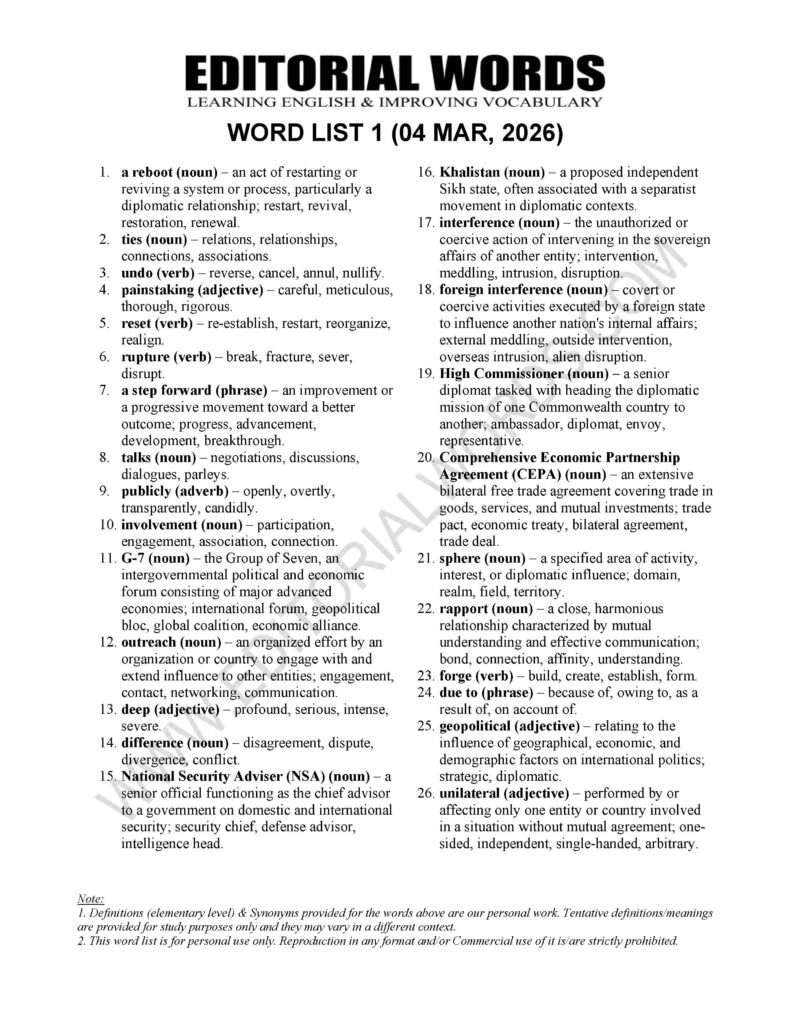
- a reboot (noun) – an act of restarting or reviving a system or process, particularly a diplomatic relationship; restart, revival, restoration, renewal.
- ties (noun) – relations, relationships, connections, associations.
- undo (verb) – reverse, cancel, annul, nullify.
- painstaking (adjective) – careful, meticulous, thorough, rigorous.
- reset (verb) – re-establish, restart, reorganize, realign.
- rupture (verb) – break, fracture, sever, disrupt.
- a step forward (phrase) – an improvement or a progressive movement toward a better outcome; progress, advancement, development, breakthrough.
- talks (noun) – negotiations, discussions, dialogues, parleys.
- publicly (adverb) – openly, overtly, transparently, candidly.
- involvement (noun) – participation, engagement, association, connection.
- G-7 (noun) – the Group of Seven, an intergovernmental political and economic forum consisting of major advanced economies; international forum, geopolitical bloc, global coalition, economic alliance.
- outreach (noun) – an organized effort by an organization or country to engage with and extend influence to other entities; engagement, contact, networking, communication.
- deep (adjective) – profound, serious, intense, severe.
- difference (noun) – disagreement, dispute, divergence, conflict.
- National Security Adviser (NSA) (noun) – a senior official functioning as the chief advisor to a government on domestic and international security; security chief, defense advisor, intelligence head.
- Khalistan (noun) – a proposed independent Sikh state, often associated with a separatist movement in diplomatic contexts.
- interference (noun) – the unauthorized or coercive action of intervening in the sovereign affairs of another entity; intervention, meddling, intrusion, disruption.
- foreign interference (noun) – covert or coercive activities executed by a foreign state to influence another nation’s internal affairs; external meddling, outside intervention, overseas intrusion, alien disruption.
- High Commissioner (noun) – a senior diplomat tasked with heading the diplomatic mission of one Commonwealth country to another; ambassador, diplomat, envoy, representative.
- Comprehensive Economic Partnership Agreement (CEPA) (noun) – an extensive bilateral free trade agreement covering trade in goods, services, and mutual investments; trade pact, economic treaty, bilateral agreement, trade deal.
- sphere (noun) – a specified area of activity, interest, or diplomatic influence; domain, realm, field, territory.
- rapport (noun) – a close, harmonious relationship characterized by mutual understanding and effective communication; bond, connection, affinity, understanding.
- forge (verb) – build, create, establish, form.
- due to (phrase) – because of, owing to, as a result of, on account of.
- geopolitical (adjective) – relating to the influence of geographical, economic, and demographic factors on international politics; strategic, diplomatic.
- unilateral (adjective) – performed by or affecting only one entity or country involved in a situation without mutual agreement; one-sided, independent, single-handed, arbitrary.
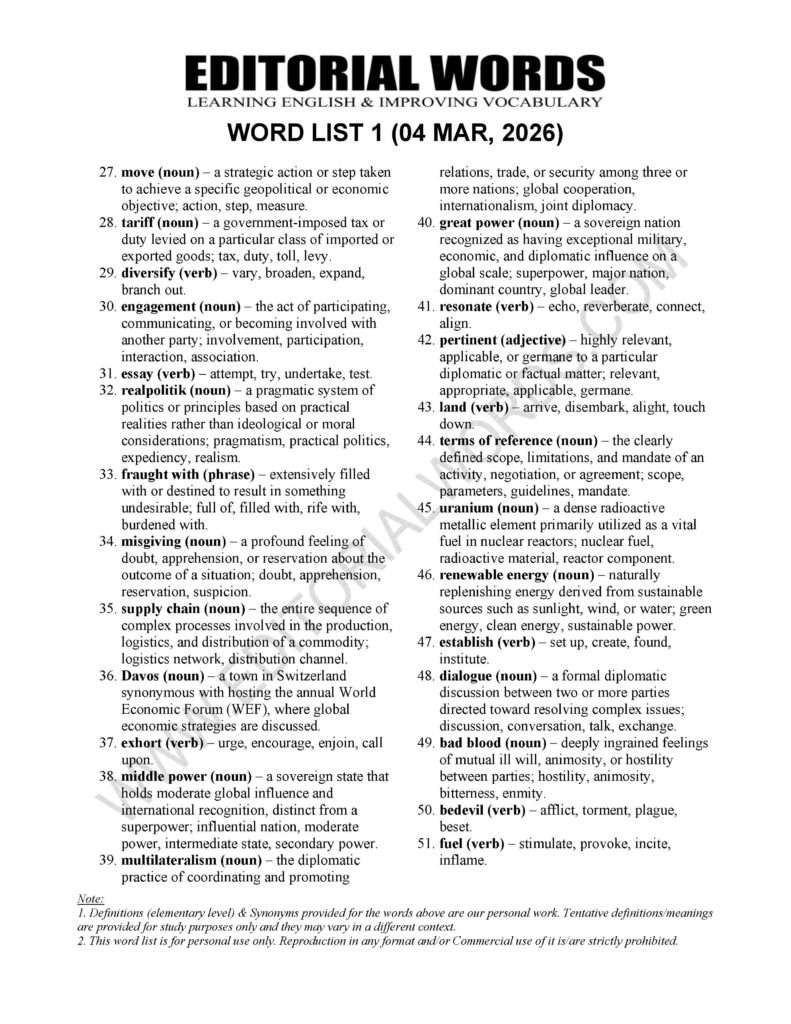
- move (noun) – a strategic action or step taken to achieve a specific geopolitical or economic objective; action, step, measure.
- tariff (noun) – a government-imposed tax or duty levied on a particular class of imported or exported goods; tax, duty, toll, levy.
- diversify (verb) – vary, broaden, expand, branch out.
- engagement (noun) – the act of participating, communicating, or becoming involved with another party; involvement, participation, interaction, association.
- essay (verb) – attempt, try, undertake, test.
- realpolitik (noun) – a pragmatic system of politics or principles based on practical realities rather than ideological or moral considerations; pragmatism, practical politics, expediency, realism.
- fraught with (phrase) – extensively filled with or destined to result in something undesirable; full of, filled with, rife with, burdened with.
- misgiving (noun) – a profound feeling of doubt, apprehension, or reservation about the outcome of a situation; doubt, apprehension, reservation, suspicion.
- supply chain (noun) – the entire sequence of complex processes involved in the production, logistics, and distribution of a commodity; logistics network, distribution channel.
- Davos (noun) – a town in Switzerland synonymous with hosting the annual World Economic Forum (WEF), where global economic strategies are discussed.
- exhort (verb) – urge, encourage, enjoin, call upon.
- middle power (noun) – a sovereign state that holds moderate global influence and international recognition, distinct from a superpower; influential nation, moderate power, intermediate state, secondary power.
- multilateralism (noun) – the diplomatic practice of coordinating and promoting relations, trade, or security among three or more nations; global cooperation, internationalism, joint diplomacy.
- great power (noun) – a sovereign nation recognized as having exceptional military, economic, and diplomatic influence on a global scale; superpower, major nation, dominant country, global leader.
- resonate (verb) – echo, reverberate, connect, align.
- pertinent (adjective) – highly relevant, applicable, or germane to a particular diplomatic or factual matter; relevant, appropriate, applicable, germane.
- land (verb) – arrive, disembark, alight, touch down.
- terms of reference (noun) – the clearly defined scope, limitations, and mandate of an activity, negotiation, or agreement; scope, parameters, guidelines, mandate.
- uranium (noun) – a dense radioactive metallic element primarily utilized as a vital fuel in nuclear reactors; nuclear fuel, radioactive material, reactor component.
- renewable energy (noun) – naturally replenishing energy derived from sustainable sources such as sunlight, wind, or water; green energy, clean energy, sustainable power.
- establish (verb) – set up, create, found, institute.
- dialogue (noun) – a formal diplomatic discussion between two or more parties directed toward resolving complex issues; discussion, conversation, talk, exchange.
- bad blood (noun) – deeply ingrained feelings of mutual ill will, animosity, or hostility between parties; hostility, animosity, bitterness, enmity.
- bedevil (verb) – afflict, torment, plague, beset.
- fuel (verb) – stimulate, provoke, incite, inflame.
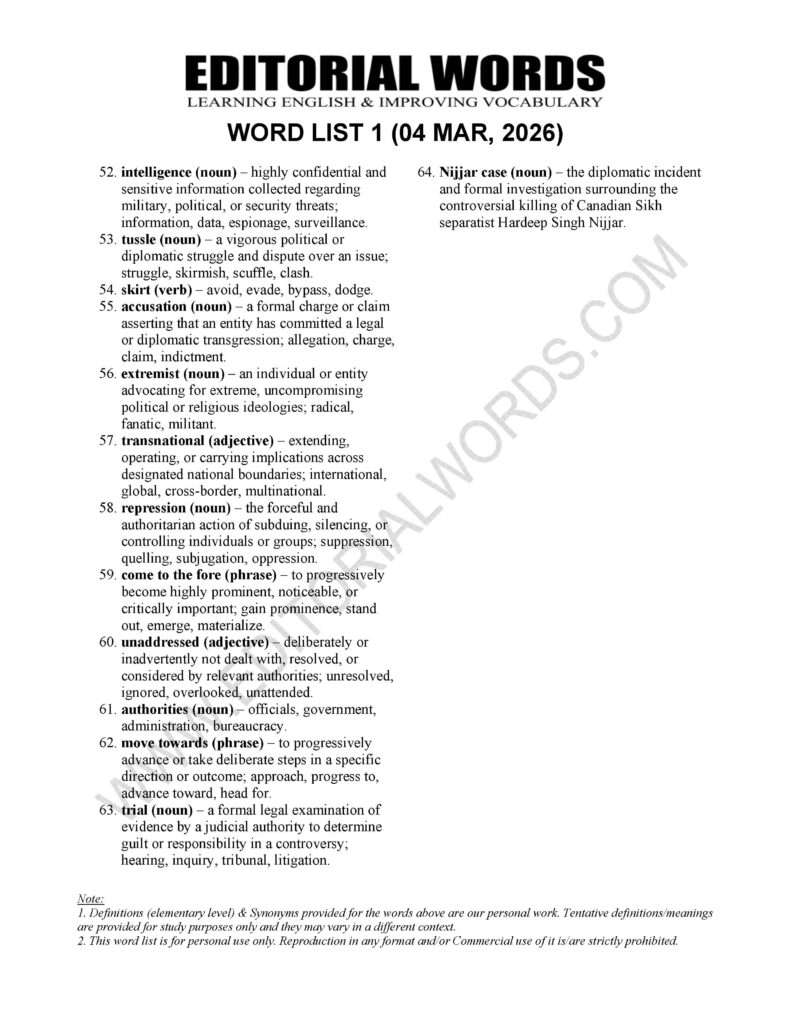
- intelligence (noun) – highly confidential and sensitive information collected regarding military, political, or security threats; information, data, espionage, surveillance.
- tussle (noun) – a vigorous political or diplomatic struggle and dispute over an issue; struggle, skirmish, scuffle, clash.
- skirt (verb) – avoid, evade, bypass, dodge.
- accusation (noun) – a formal charge or claim asserting that an entity has committed a legal or diplomatic transgression; allegation, charge, claim, indictment.
- extremist (noun) – an individual or entity advocating for extreme, uncompromising political or religious ideologies; radical, fanatic, militant.
- transnational (adjective) – extending, operating, or carrying implications across designated national boundaries; international, global, cross-border, multinational.
- repression (noun) – the forceful and authoritarian action of subduing, silencing, or controlling individuals or groups; suppression, quelling, subjugation, oppression.
- come to the fore (phrase) – to progressively become highly prominent, noticeable, or critically important; gain prominence, stand out, emerge, materialize.
- unaddressed (adjective) – deliberately or inadvertently not dealt with, resolved, or considered by relevant authorities; unresolved, ignored, overlooked, unattended.
- authorities (noun) – officials, government, administration, bureaucracy.
- move towards (phrase) – to progressively advance or take deliberate steps in a specific direction or outcome; approach, progress to, advance toward, head for.
- trial (noun) – a formal legal examination of evidence by a judicial authority to determine guilt or responsibility in a controversy; hearing, inquiry, tribunal, litigation.
- Nijjar case (noun) – the diplomatic incident and formal investigation surrounding the controversial killing of Canadian Sikh separatist Hardeep Singh Nijjar.
1. Click each one of the words above for their definition, more synonyms, pronunciation, example sentences, phrases, derivatives, origin and etc. from http://www.oxforddictionaries.com/.
2. Definitions (elementary level) & Synonyms provided for the words above are my personal work and not that of Oxford University Press. Tentative definitions/meanings are provided for study purposes only and they may vary in a different context.
3. This word list is for personal use only. Reproduction in any format and/or Commercial use of it is/are strictly prohibited.
The Hindu Editorial (Reboot) – Mar 04, 2026:
“Idioms & Phrases” We Learnt Last Week
“Important Definitions” We Learnt Last Week
Recent Word Lists For The Hindu Editorial Articles
India and Canada have had to take a painstaking path to reset ties ruptured over the Nijjar killing in 2023. But this week saw a big step forward, with Canadian Prime Minister Mark Carney’s India visit and his talks with Prime Minister Narendra Modi… For further reading, visit “The Hindu”. Below is today’s word list-1 for The Hindu Editorial (A reboot) – Mar 04, 2026.