
The Hindu Editorial (Selective outrage) – Mar 02, 2026
To read this article, click “The Hindu”.
This preview is provided here with permission.
Courtesy: The Hindu
The Hindu Editorial (Selective outrage) – Mar 02, 2026:
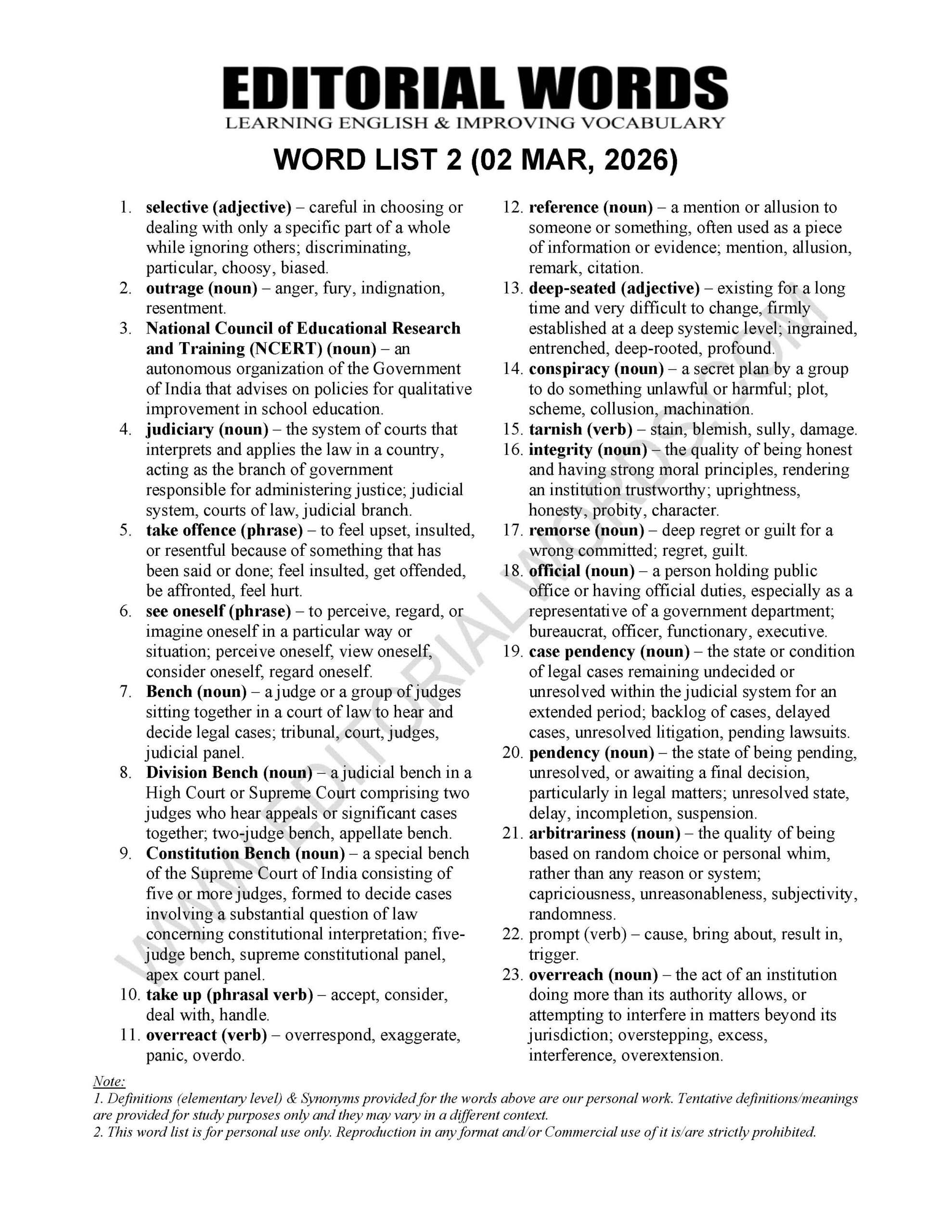
- selective (adjective) – careful in choosing or dealing with only a specific part of a whole while ignoring others; discriminating, particular, choosy, biased.
- outrage (noun) – anger, fury, indignation, resentment.
- National Council of Educational Research and Training (NCERT) (noun) – an autonomous organization of the Government of India that advises on policies for qualitative improvement in school education.
- judiciary (noun) – the system of courts that interprets and applies the law in a country, acting as the branch of government responsible for administering justice; judicial system, courts of law, judicial branch.
- take offence (phrase) – to feel upset, insulted, or resentful because of something that has been said or done; feel insulted, get offended, be affronted, feel hurt.
- see oneself (phrase) – to perceive, regard, or imagine oneself in a particular way or situation; perceive oneself, view oneself, consider oneself, regard oneself.
- Bench (noun) – a judge or a group of judges sitting together in a court of law to hear and decide legal cases; tribunal, court, judges, judicial panel.
- Division Bench (noun) – a judicial bench in a High Court or Supreme Court comprising two judges who hear appeals or significant cases together; two-judge bench, appellate bench.
- Constitution Bench (noun) – a special bench of the Supreme Court of India consisting of five or more judges, formed to decide cases involving a substantial question of law concerning constitutional interpretation; five-judge bench, supreme constitutional panel, apex court panel.
- take up (phrasal verb) – accept, consider, deal with, handle.
- overreact (verb) – overrespond, exaggerate, panic, overdo.
- reference (noun) – a mention or allusion to someone or something, often used as a piece of information or evidence; mention, allusion, remark, citation.
- deep-seated (adjective) – existing for a long time and very difficult to change, firmly established at a deep systemic level; ingrained, entrenched, deep-rooted, profound.
- conspiracy (noun) – a secret plan by a group to do something unlawful or harmful; plot, scheme, collusion, machination.
- tarnish (verb) – stain, blemish, sully, damage.
- integrity (noun) – the quality of being honest and having strong moral principles, rendering an institution trustworthy; uprightness, honesty, probity, character.
- remorse (noun) – deep regret or guilt for a wrong committed; regret, guilt.
- official (noun) – a person holding public office or having official duties, especially as a representative of a government department; bureaucrat, officer, functionary, executive.
- case pendency (noun) – the state or condition of legal cases remaining undecided or unresolved within the judicial system for an extended period; backlog of cases, delayed cases, unresolved litigation, pending lawsuits.
- pendency (noun) – the state of being pending, unresolved, or awaiting a final decision, particularly in legal matters; unresolved state, delay, incompletion, suspension.
- arbitrariness (noun) – the quality of being based on random choice or personal whim, rather than any reason or system; capriciousness, unreasonableness, subjectivity, randomness.
- prompt (verb) – cause, bring about, result in, trigger.
- overreach (noun) – the act of an institution doing more than its authority allows, or attempting to interfere in matters beyond its jurisdiction; overstepping, excess, interference, overextension.
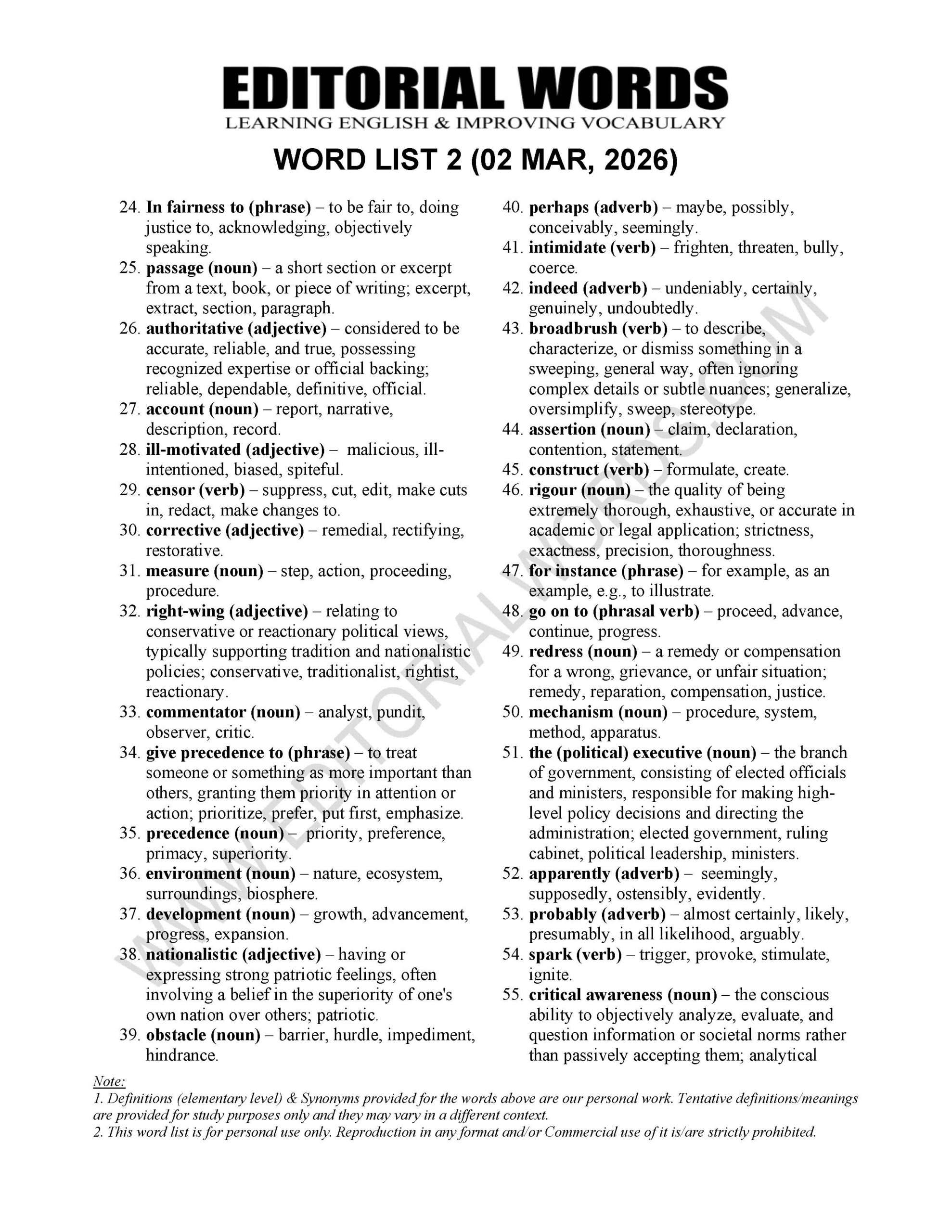
- In fairness to (phrase) – to be fair to, doing justice to, acknowledging, objectively speaking.
- passage (noun) – a short section or excerpt from a text, book, or piece of writing; excerpt, extract, section, paragraph.
- authoritative (adjective) – considered to be accurate, reliable, and true, possessing recognized expertise or official backing; reliable, dependable, definitive, official.
- account (noun) – report, narrative, description, record.
- ill-motivated (adjective) – malicious, ill-intentioned, biased, spiteful.
- censor (verb) – suppress, cut, edit, make cuts in, redact, make changes to.
- corrective (adjective) – remedial, rectifying, restorative.
- measure (noun) – step, action, proceeding, procedure.
- right-wing (adjective) – relating to conservative or reactionary political views, typically supporting tradition and nationalistic policies; conservative, traditionalist, rightist, reactionary.
- commentator (noun) – analyst, pundit, observer, critic.
- give precedence to (phrase) – to treat someone or something as more important than others, granting them priority in attention or action; prioritize, prefer, put first, emphasize.
- precedence (noun) – priority, preference, primacy, superiority.
- environment (noun) – nature, ecosystem, surroundings, biosphere.
- development (noun) – growth, advancement, progress, expansion.
- nationalistic (adjective) – having or expressing strong patriotic feelings, often involving a belief in the superiority of one’s own nation over others; patriotic.
- obstacle (noun) – barrier, hurdle, impediment, hindrance.
- perhaps (adverb) – maybe, possibly, conceivably, seemingly.
- intimidate (verb) – frighten, threaten, bully, coerce.
- indeed (adverb) – undeniably, certainly, genuinely, undoubtedly.
- broadbrush (verb) – to describe, characterize, or dismiss something in a sweeping, general way, often ignoring complex details or subtle nuances; generalize, oversimplify, sweep, stereotype.
- assertion (noun) – claim, declaration, contention, statement.
- construct (verb) – formulate, create.
- rigour (noun) – the quality of being extremely thorough, exhaustive, or accurate in academic or legal application; strictness, exactness, precision, thoroughness.
- for instance (phrase) – for example, as an example, e.g., to illustrate.
- go on to (phrasal verb) – proceed, advance, continue, progress.
- redress (noun) – a remedy or compensation for a wrong, grievance, or unfair situation; remedy, reparation, compensation, justice.
- mechanism (noun) – procedure, system, method, apparatus.
- the (political) executive (noun) – the branch of government, consisting of elected officials and ministers, responsible for making high-level policy decisions and directing the administration; elected government, ruling cabinet, political leadership, ministers.
- apparently (adverb) – seemingly, supposedly, ostensibly, evidently.
- probably (adverb) – almost certainly, likely, presumably, in all likelihood, arguably.
- spark (verb) – trigger, provoke, stimulate, ignite.
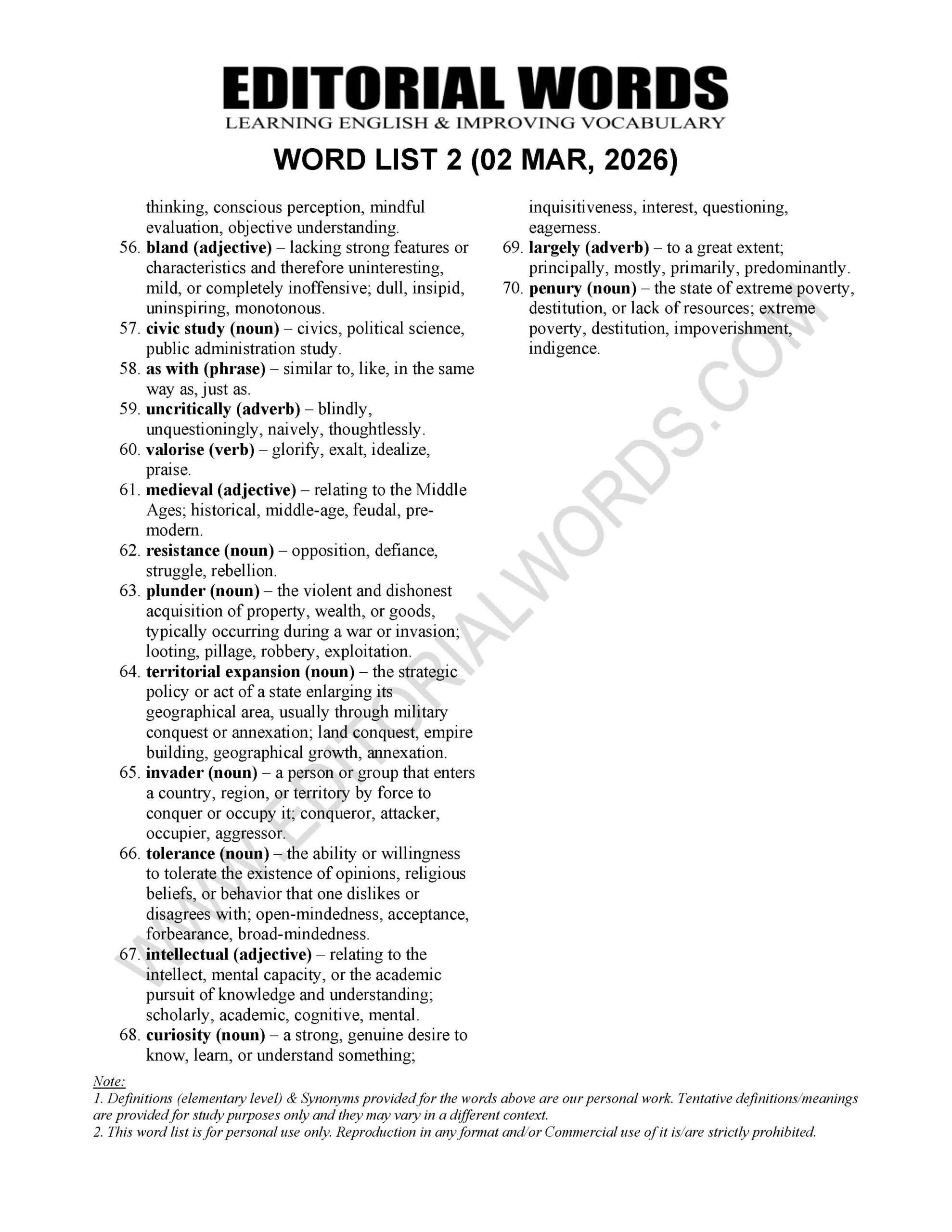
- critical awareness (noun) – the conscious ability to objectively analyze, evaluate, and question information or societal norms rather than passively accepting them; analytical thinking, conscious perception, mindful evaluation, objective understanding.
- bland (adjective) – lacking strong features or characteristics and therefore uninteresting, mild, or completely inoffensive; dull, insipid, uninspiring, monotonous.
- civic study (noun) – civics, political science, public administration study.
- as with (phrase) – similar to, like, in the same way as, just as.
- uncritically (adverb) – blindly, unquestioningly, naively, thoughtlessly.
- valorise (verb) – glorify, exalt, idealize, praise.
- medieval (adjective) – relating to the Middle Ages; historical, middle-age, feudal, pre-modern.
- resistance (noun) – opposition, defiance, struggle, rebellion.
- plunder (noun) – the violent and dishonest acquisition of property, wealth, or goods, typically occurring during a war or invasion; looting, pillage, robbery, exploitation.
- territorial expansion (noun) – the strategic policy or act of a state enlarging its geographical area, usually through military conquest or annexation; land conquest, empire building, geographical growth, annexation.
- invader (noun) – a person or group that enters a country, region, or territory by force to conquer or occupy it; conqueror, attacker, occupier, aggressor.
- tolerance (noun) – the ability or willingness to tolerate the existence of opinions, religious beliefs, or behavior that one dislikes or disagrees with; open-mindedness, acceptance, forbearance, broad-mindedness.
- intellectual (adjective) – relating to the intellect, mental capacity, or the academic pursuit of knowledge and understanding; scholarly, academic, cognitive, mental.
- curiosity (noun) – a strong, genuine desire to know, learn, or understand something; inquisitiveness, interest, questioning, eagerness.
- largely (adverb) – to a great extent; principally, mostly, primarily, predominantly.
- penury (noun) – the state of extreme poverty, destitution, or lack of resources; extreme poverty, destitution, impoverishment, indigence.
1. Click each one of the words above for their definition, more synonyms, pronunciation, example sentences, phrases, derivatives, origin and etc. from http://www.oxforddictionaries.com/.
2. Definitions (elementary level) & Synonyms provided for the words above are my personal work and not that of Oxford University Press. Tentative definitions/meanings are provided for study purposes only and they may vary in a different context.
3. This word list is for personal use only. Reproduction in any format and/or Commercial use of it is/are strictly prohibited.
The Hindu Editorial (Selective outrage) – Mar 02, 2026:
“Idioms & Phrases” We Learnt Last Week
“Important Definitions” We Learnt Last Week
Recent Word Lists For The Hindu Editorial Articles
The Supreme Court Bench that took up the NCERT Class 8 social science textbook case might have overreacted when it saw the critical references to the judiciary as a “deep-seated conspiracy” and declared that it will not allow “anyone on earth” to… For further reading, visit “The Hindu”. Below is today’s word list-2 for The Hindu Editorial (Selective outrage) – Mar 02, 2026.