

The Hindu Editorial (Sedition redux) – Aug 20, 2025
To read this article, click “The Hindu”.
This preview is provided here with permission.
Courtesy: The Hindu
The Hindu Editorial (Sedition redux) – Aug 20, 2025:
- sedition (noun) – incitement (to riot/rebellion), agitation, trouble making/provocation (against the established government/authority).
- redux (adjective) – brought back; revived, restored (used postpositively, that means it comes after the word it explains).
- trample on (verb) – crush, press down, squash, step on; disregard, show no consideration for, treat disrespectfully, treat with contempt.
- trampling (noun) – disregarding, treating disrespectfully/with contempt; taking for granted. (trample means walking on someone/something to damage/spoil).
- freedom of expression (noun) – the ability of an individual or group of individuals to express their beliefs, thoughts, ideas, and emotions about different issues free from government censorship, restraint, or legal penalty.
- frivolous (adjective) – relating to something which is having no serious, sensible, useful purpose or value and it will also be a waste of time; valueless, insignificant, silly.
- publication (noun) – it refers to the process of making content, such as information, articles, reports, books, or other materials, available to the public or a specified audience. This can include various forms of distribution, such as print media (like books, magazines, or newspapers), online platforms, or broadcast channels.
- summon (verb) – order someone to be present; call for, ask for, request the presence of.
- perusal (noun) – reading, scrutiny, inspection, study, examination.
- material evidence (noun) – real evidence, physical evidence.
- Playbook (noun) – a set of strategies.
- vindictive (adjective) – vengeful, revengeful, avenging, ill-disposed, acrimonious, bitter.
- brook (verb) – tolerate, put up with, allow/accept (something like dissent/difference of opinion)
- reportedly (adverb) – supposedly, seemingly, apparently, allegedly, professedly, ostensibly, purportedly.
- Section 152 of the Bharatiya Nyaya Sanhita (BNS) (noun) – it punishes “acts endangering sovereignty, unity and integrity of India
- Bharatiya Nyaya Sanhita (BNS) Act, 2023 (noun) – An Act to consolidate and amend the provisions relating to offences and for matters connected therewith or incidental thereto. It is the official criminal code in India and it replaced the Indian Penal Code (IPC). It came into effect on 1 July 2024 after being passed by the parliament in December 2023.
- Section 124A of the IPC (noun) – Section 124A of the Indian Penal Code lays down the punishment for sedition. Section 152 of the BNS, though worded differently and avoiding the term ‘sedition’, was “in essence” the colonial sedition provision of Section 124A of the Indian Penal Code (IPC).
- Indian Penal Code (IPC) (noun) – The Indian Penal Code (IPC) is the official criminal code of India. It is a comprehensive code intended to cover all substantive aspects of criminal law. The draft was passed into law on 6 October 1860. The Code came into operation on 1 January 1862. The Indian Penal Code of 1860, subdivided into 23 chapters, comprises 511 sections. IPC deals with crimes and punishments.
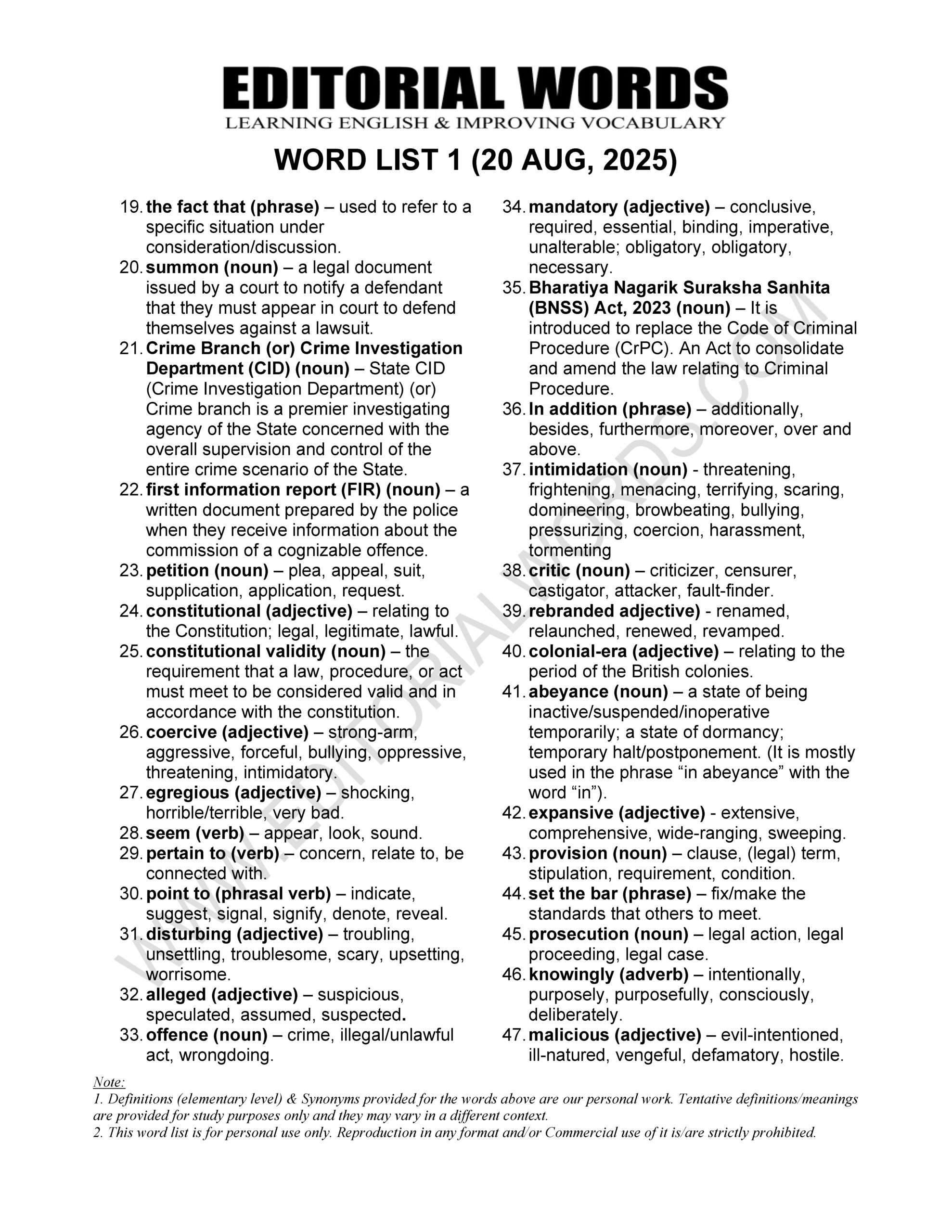
- the fact that (phrase) – used to refer to a specific situation under consideration/discussion.
- summon (noun) – a legal document issued by a court to notify a defendant that they must appear in court to defend themselves against a lawsuit.
- Crime Branch (or) Crime Investigation Department (CID) (noun) – State CID (Crime Investigation Department) (or) Crime branch is a premier investigating agency of the State concerned with the overall supervision and control of the entire crime scenario of the State.
- first information report (FIR) (noun) – a written document prepared by the police when they receive information about the commission of a cognizable offence.
- petition (noun) – plea, appeal, suit, supplication, application, request.
- constitutional (adjective) – relating to the Constitution; legal, legitimate, lawful.
- constitutional validity (noun) – the requirement that a law, procedure, or act must meet to be considered valid and in accordance with the constitution.
- coercive (adjective) – strong-arm, aggressive, forceful, bullying, oppressive, threatening, intimidatory.
- egregious (adjective) – shocking, horrible/terrible, very bad.
- seem (verb) – appear, look, sound.
- pertain to (verb) – concern, relate to, be connected with.
- point to (phrasal verb) – indicate, suggest, signal, signify, denote, reveal.
- disturbing (adjective) – troubling, unsettling, troublesome, scary, upsetting, worrisome.
- alleged (adjective) – suspicious, speculated, assumed, suspected.
- offence (noun) – crime, illegal/unlawful act, wrongdoing.
- mandatory (adjective) – conclusive, required, essential, binding, imperative, unalterable; obligatory, obligatory, necessary.
- Bharatiya Nagarik Suraksha Sanhita (BNSS) Act, 2023 (noun) – It is introduced to replace the Code of Criminal Procedure (CrPC). An Act to consolidate and amend the law relating to Criminal Procedure.
- In addition (phrase) – additionally, besides, furthermore, moreover, over and above.
- intimidation (noun) – threatening, frightening, menacing, terrifying, scaring, domineering, browbeating, bullying, pressurizing, coercion, harassment, tormenting
- critic (noun) – criticizer, censurer, castigator, attacker, fault-finder.
- rebranded adjective) – renamed, relaunched, renewed, revamped.
- colonial-era (adjective) – relating to the period of the British colonies.
- abeyance (noun) – a state of being inactive/suspended/inoperative temporarily; a state of dormancy; temporary halt/postponement. (It is mostly used in the phrase “in abeyance” with the word “in”).
- expansive (adjective) – extensive, comprehensive, wide-ranging, sweeping.
- provision (noun) – clause, (legal) term, stipulation, requirement, condition.
- set the bar (phrase) – fix/make the standards that others to meet.
- prosecution (noun) – legal action, legal proceeding, legal case.
- knowingly (adverb) – intentionally, purposely, purposefully, consciously, deliberately.
- malicious (adjective) – evil-intentioned, ill-natured, vengeful, defamatory, hostile.
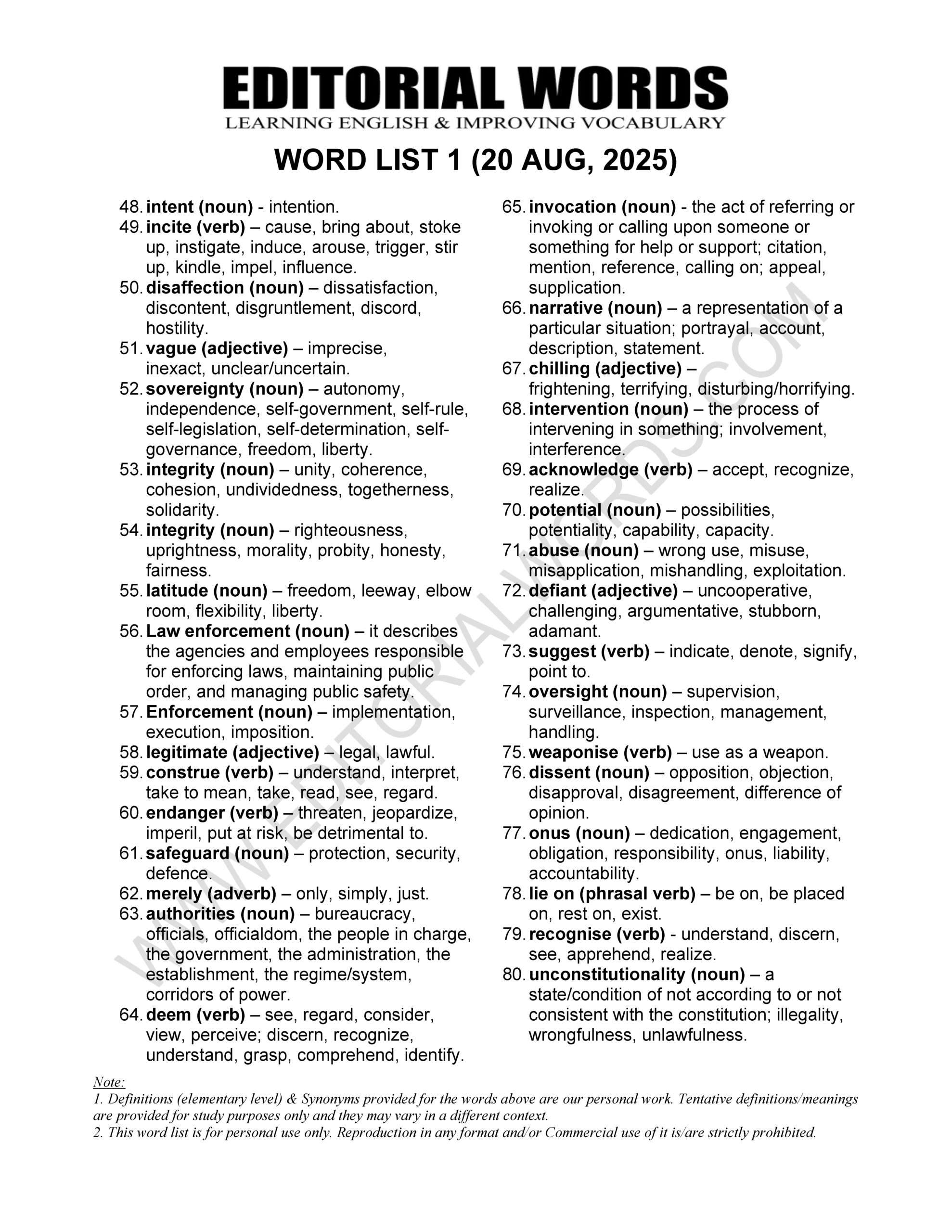
- intent (noun) – intention.
- incite (verb) – cause, bring about, stoke up, instigate, induce, arouse, trigger, stir up, kindle, impel, influence.
- disaffection (noun) – dissatisfaction, discontent, disgruntlement, discord, hostility.
- vague (adjective) – imprecise, inexact, unclear/uncertain.
- language
- sovereignty (noun) – autonomy, independence, self-government, self-rule, self-legislation, self-determination, self-governance, freedom, liberty.
- integrity (noun) – unity, coherence, cohesion, undividedness, togetherness, solidarity.
- integrity (noun) – righteousness, uprightness, morality, probity, honesty, fairness.
- latitude (noun) – freedom, leeway, elbow room, flexibility, liberty.
- Law enforcement (noun) – it describes the agencies and employees responsible for enforcing laws, maintaining public order, and managing public safety.
- Enforcement (noun) – implementation, execution, imposition.
- legitimate (adjective) – legal, lawful, valid, acceptable.
- construe (verb) – understand, interpret, take to mean, take, read, see, regard.
- endanger (verb) – threaten, jeopardize, imperil, put at risk, be detrimental to.
- safeguard (noun) – protection, security, defence.
- merely (adverb) – only, simply, just.
- authorities (noun) – bureaucracy, officials, officialdom, the people in charge, the government, the administration, the establishment, the regime/system, corridors of power.
- deem (verb) – see, regard, consider, view, perceive ; discern, recognize, understand, grasp, comprehend, identify.
- invocation (noun) – the act of referring or invoking or calling upon someone or something for help or support; citation, mention, reference, calling on; appeal, supplication.
- narrative (noun) – a representation of a particular situation; portrayal, account, description, statement.
- chilling (adjective) – frightening, terrifying, disturbing/horrifying.
- intervention (noun) – the process of intervening in something; involvement, interference.
- acknowledge (verb) – accept, recognize, realize.
- potential (noun) – possibilities, potentiality, capability, capacity.
- abuse (noun) – wrong use, misuse, misapplication, mishandling, exploitation.
- defiant (adjective) – uncooperative, challenging, argumentative, stubborn, adamant.
- suggest (verb) – indicate, denote, signify, point to.
- oversight (noun) – supervision, surveillance, inspection, management, handling.
- weaponise (verb) – use as a weapon.
- dissent (noun) – opposition, objection, disapproval, disagreement, difference of opinion.
- onus (noun) – dedication, engagement, obligation, responsibility, onus, liability, accountability.
- lie on (phrasal verb) – be on, be placed on, rest on, exist.
- recognise (verb) – understand, discern, see, apprehend, realize.
- unconstitutionality (noun) – a state/condition of not according to or not consistent with the constitution; illegality, wrongfulness, unlawfulness.
Note :
1. Click each one of the words above for their definition, more synonyms, pronunciation, example sentences, phrases, derivatives, origin and etc. from http://www.oxforddictionaries.com/.
2. Definitions (elementary level) & Synonyms provided for the words above are my personal work and not that of Oxford University Press. Tentative definitions/meanings are provided for study purposes only and they may vary in a different context.
3. This word list is for personal use only. Reproduction in any format and/or Commercial use of it is/are strictly prohibited.
The Hindu Editorial (Sedition redux) – Aug 20, 2025:


“Idioms & Phrases” We Learnt Last Week
“Important Definitions” We Learnt Last Week
Recent Word Lists For The Hindu Editorial Articles
Filing frivolous cases against publications and summoning journalists without proper investigation or perusal of material evidence have become a part of the police playbook in States ruled by vindictive politicians who brook no criticism… For further reading, visit “The Hindu”. Below is today’s word list-2 for The Hindu Editorial (Sedition redux) – Aug 20, 2025.