

The Hindu Editorial (Punishing process) – Aug 21, 2025
To read this article, click “The Hindu”.
This preview is provided here with permission.
Courtesy: The Hindu
The Hindu Editorial (Punishing process) – Aug 21, 2025:
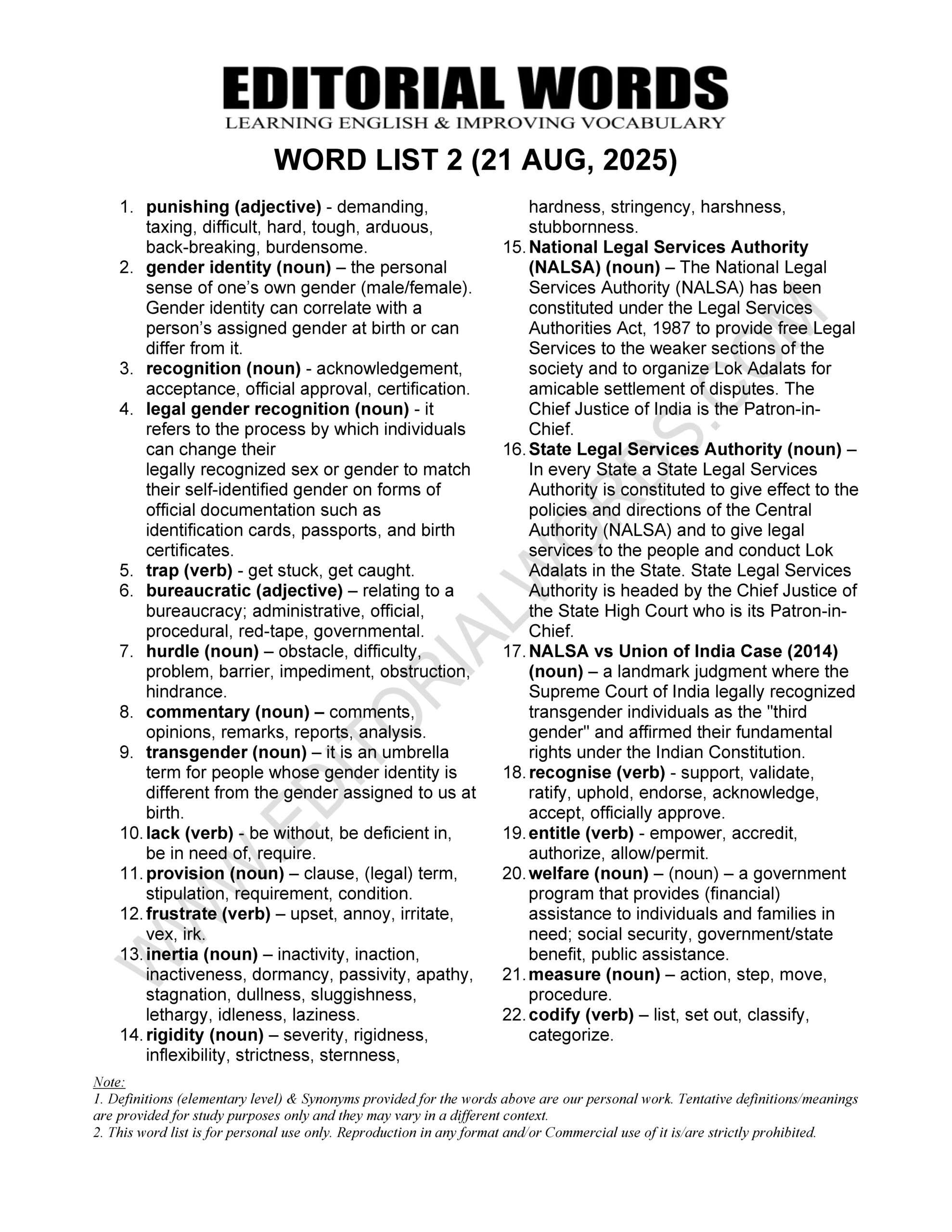
- punishing (adjective) – demanding, taxing, difficult, hard, tough, arduous, back-breaking, burdensome.
- gender identity (noun) – the personal sense of one’s own gender (male/female). Gender identity can correlate with a person’s assigned gender at birth or can differ from it.
- recognition (noun) – acknowledgement, acceptance, official approval, certification.
- legal gender recognition (noun) – it refers to the process by which individuals can change their
legally recognized sex or gender to match their self-identified gender on forms of
official documentation such as identification cards, passports, and birth certificates. - trap (verb) – get stuck, get caught.
- bureaucratic (adjective) – relating to a bureaucracy; administrative, official, procedural, red-tape, governmental.
- hurdle (noun) – obstacle, difficulty, problem, barrier, impediment, obstruction, hindrance.
- commentary (noun) – comments, opinions, remarks, reports, analysis.
- transgender (noun) – it is an umbrella term for people whose gender identity is different from the gender assigned to us at birth.
- lack (verb) – be without, be deficient in, be in need of, require.
- provision (noun) – clause, (legal) term, stipulation, requirement, condition.
- implementation (noun) – enforcement, execution, imposition.
- frustrate (verb) – upset, annoy, irritate, vex, irk.
- inertia (noun) – inactivity, inaction, inactiveness, dormancy, passivity, apathy, stagnation, dullness, sluggishness, lethargy, idleness, laziness.
- rigidity (noun) – severity, rigidness, inflexibility, strictness, sternness, hardness, stringency, harshness, stubbornness.
- National Legal Services Authority (NALSA) (noun) – The National Legal Services Authority (NALSA) has been constituted under the Legal Services Authorities Act, 1987 to provide free Legal Services to the weaker sections of the society and to organize Lok Adalats for amicable settlement of disputes. The Chief Justice of India is the Patron-in-Chief.
- State Legal Services Authority (noun) – In every State a State Legal Services Authority is constituted to give effect to the policies and directions of the Central Authority (NALSA) and to give legal services to the people and conduct Lok Adalats in the State. State Legal Services Authority is headed by the Chief Justice of the State High Court who is its Patron-in-Chief.
- NALSA vs Union of India Case (2014) (noun) – a landmark judgment where the Supreme Court of India legally recognized transgender individuals as the “third gender” and affirmed their fundamental rights under the Indian Constitution.
- recognise (verb) – support, validate, ratify, uphold, endorse, acknowledge, accept,
officially approve.
- entitle (verb) – empower, accredit, authorize, allow/permit.
- welfare (noun) – (noun) – a government program that provides (financial) assistance to individuals and families in need; social security, government/state benefit, public assistance.
- measure (noun) – action, step, move, procedure.
- codify (verb) – list, set out, classify, categorize.
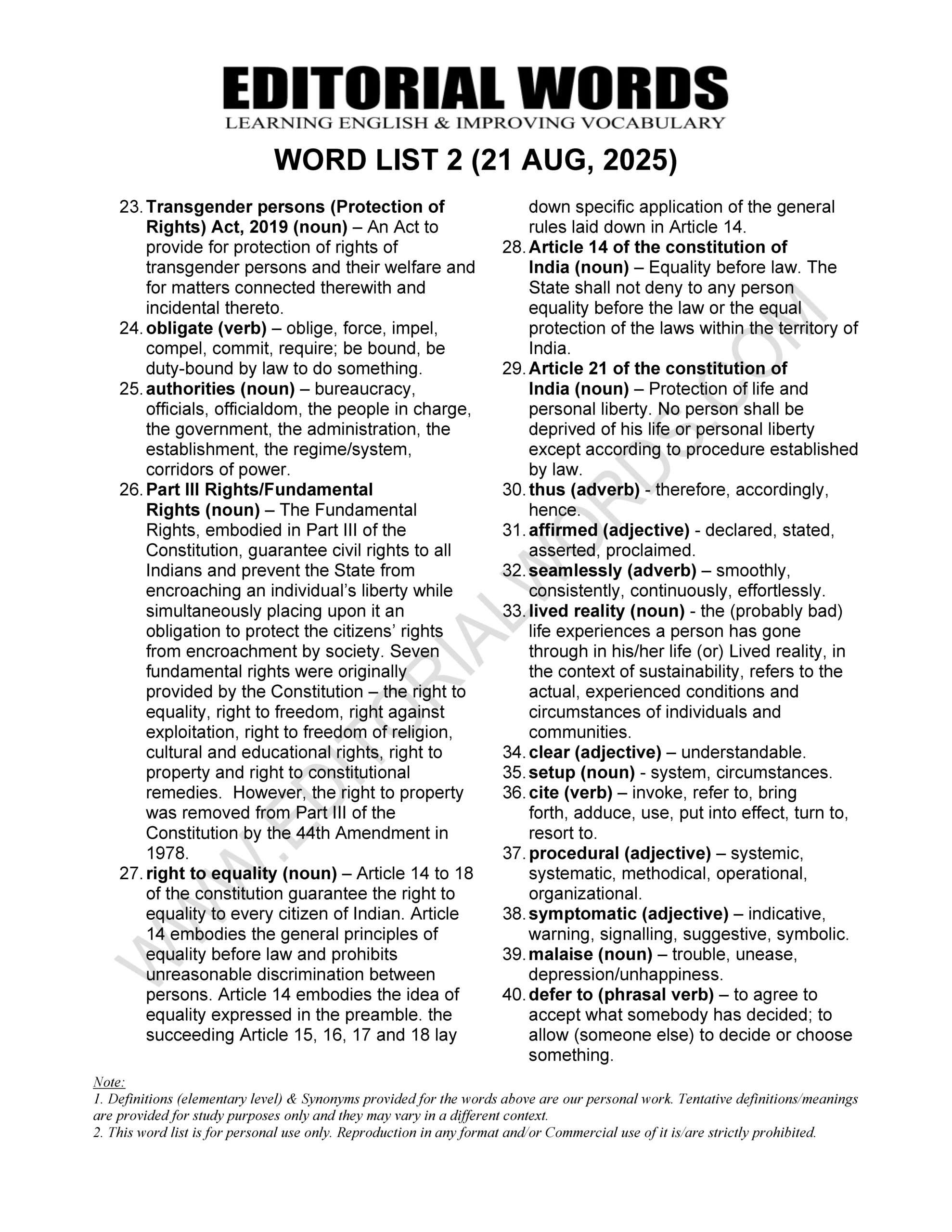
- Transgender persons (Protection of Rights) Act, 2019 (noun) – An Act to provide for protection of rights of transgender persons and their welfare and for matters connected therewith and incidental thereto.
- obligate (verb) – oblige, force, impel, compel, commit, require; be bound, be duty-bound by law to do something.
- authorities (noun) – bureaucracy, officials, officialdom, the people in charge, the government, the administration, the establishment, the regime/system, corridors of power.
- Part III Rights/Fundamental Rights (noun) – The Fundamental Rights, embodied in Part III of the Constitution, guarantee civil rights to all Indians and prevent the State from encroaching an individual’s liberty while simultaneously placing upon it an obligation to protect the citizens’ rights from encroachment by society. Seven fundamental rights were originally provided by the Constitution – the right to equality, right to freedom, right against exploitation, right to freedom of religion, cultural and educational rights, right to property and right to constitutional remedies. However, the right to property was removed from Part III of the Constitution by the 44th Amendment in 1978.
- right to equality (noun) – Article 14 to 18 of the constitution guarantee the right to equality to every citizen of Indian. Article 14 embodies the general principles of equality before law and prohibits unreasonable discrimination between persons. Article 14 embodies the idea of equality expressed in the preamble. the succeeding Article 15, 16, 17 and 18 lay down specific application of the general rules laid down in Article 14.
- Article 14 of the constitution of India (noun) – Equality before law. The State shall not deny to any person equality before the law or the equal protection of the laws within the territory of India.
- Article 21 of the constitution of India (noun) – Protection of life and personal liberty. No person shall be deprived of his life or personal liberty except according to procedure established by law.
- thus (adverb) – therefore, accordingly, hence.
- affirmed (adjective) – declared, stated, asserted, proclaimed.
- seamlessly (adverb) – smoothly, consistently, continuously, effortlessly.
- lived reality (noun) – the (probably bad) life experiences a person has gone through in his/her life (or) Lived reality, in the context of sustainability, refers to the actual, experienced conditions and circumstances of individuals and communities.
-
clear (adjective) – understandable, clear-cut.
- setup (noun) – system, structure, circumstances.
- cite (verb) – invoke, refer to, bring forth, adduce, use, put into effect, turn to, resort to.
- procedural (adjective) – systemic, systematic, methodical, operational, organizational.
- symptomatic (adjective) – indicative, warning, signalling, suggestive, symbolic.
- malaise (noun) – trouble, unease, depression/unhappiness.
- defer to (phrasal verb) – to agree to accept what somebody has decided; to allow (someone else) to decide or choose something.
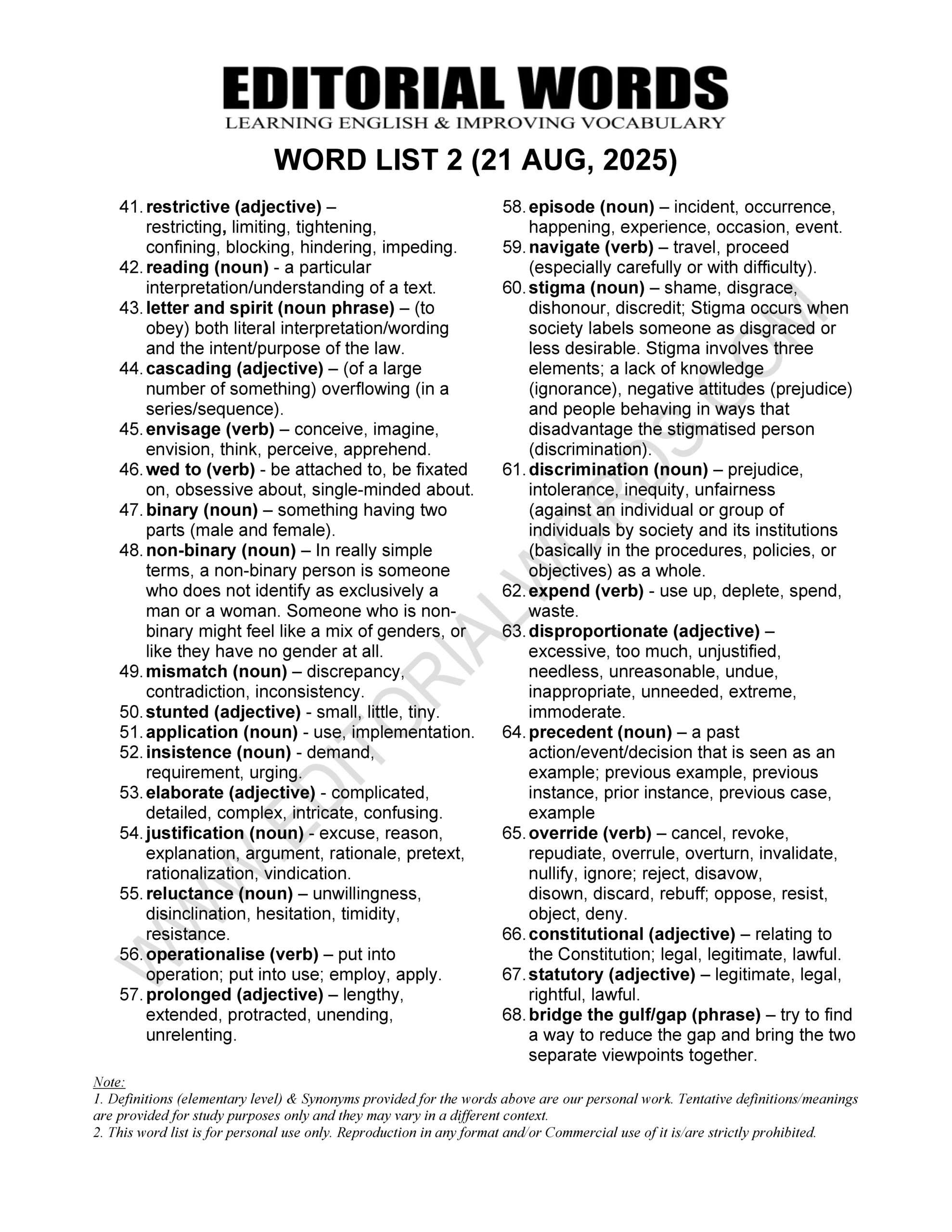
- restrictive (adjective) – restricting, limiting, tightening, confining, blocking, hindering, impeding.
- reading (noun) – a particular interpretation/understanding of a text.
- letter and spirit (noun phrase) – (to obey) both literal interpretation/wording and the intent/purpose of the law.
- cascading (adjective) – (of a large number of something) overflowing (in a series/sequence).
- envisage (verb) – conceive, imagine, envision, think, perceive, apprehend.
- wed to (verb) – be attached to, be fixated on, obsessive about, single-minded about.
- binary (noun) – something having two parts (male and female).
- non-binary (noun) – In really simple terms, a non-binary person is someone who does not identify as exclusively a man or a woman. Someone who is non-binary might feel like a mix of genders, or like they have no gender at all.
- mismatch (noun) – discrepancy, contradiction, inconsistency.
- translate into (verb) – change, transform, transfigure, convert, alter.
- stunted (adjective) – small, little, tiny.
- application (noun) – use, implementation, applying.
- insistence (noun) – demand, requirement, urging.
- elaborate (adjective) – complicated, detailed, complex, intricate, confusing.
- justification (noun) – excuse, reason, explanation, argument, rationale, pretext, rationalization, vindication.
- reluctance (noun) – unwillingness, disinclination, hesitation, timidity, resistance.
- operationalise (verb) – put into operation; put into use; employ, apply.
- prolonged (adjective) – lengthy, extended, protracted, unending, unrelenting.
- episode (noun) – incident, occurrence, happening, experience, occasion, time, event.
- navigate (verb) – travel, proceed (especially carefully or with difficulty).
- stigmatisation (noun) – a negative attitude or idea about a mental, physical, or social feature of a person or group of people that implies social disapproval. accusation, cursing, denouncement, discredit, dishonor, disparagement.
- stigma (noun) – shame, disgrace, dishonour, discredit; Stigma occurs when society labels someone as disgraced or less desirable. Stigma involves three elements; a lack of knowledge (ignorance), negative attitudes (prejudice) and people behaving in ways that disadvantage the stigmatised person (discrimination).
- discrimination (noun) – prejudice, intolerance, inequity, unfairness (against an individual or group of individuals by society and its institutions (basically in the procedures, policies, or objectives) as a whole.
- expend (verb) – use up, deplete, spend, waste.
- disproportionate (adjective) – excessive, too much, unjustified, needless, unreasonable, undue, inappropriate, unneeded, extreme, immoderate.
- precedent (noun) – a past action/event/decision that is seen as an example; previous example, previous instance, prior instance, previous case, example
- override (verb) – cancel, revoke, repudiate, overrule, overturn, invalidate, nullify, ignore; reject, disavow, disown, discard, rebuff; oppose, resist, object, deny.
- constitutional (adjective) – relating to the Constitution; legal, legitimate, lawful.
- statutory (adjective) – legitimate, legal, rightful, lawful.
- bridge the gulf/gap (phrase) – try to find a way to reduce the gap and bring the two separate viewpoints together.
Note :
1. Click each one of the words above for their definition, more synonyms, pronunciation, example sentences, phrases, derivatives, origin and etc. from http://www.oxforddictionaries.com/.
2. Definitions (elementary level) & Synonyms provided for the words above are my personal work and not that of Oxford University Press. Tentative definitions/meanings are provided for study purposes only and they may vary in a different context.
3. This word list is for personal use only. Reproduction in any format and/or Commercial use of it is/are strictly prohibited.
The Hindu Editorial (Punishing process) – Aug 21, 2025:

“Idioms & Phrases” We Learnt Last Week
“Important Definitions” We Learnt Last Week
Recent Word Lists For The Hindu Editorial Articles
The Manipur High Court’s order to the State to issue fresh academic certificates to Beoncy Laishram is at once a matter of individual justice and a larger commentary on the state of transgender rights… For further reading, visit “The Hindu”. Below is today’s word list-2 for The Hindu Editorial (Punishing process) – Aug 21, 2025.