
The Hindu Editorial (Lawfare politics) – Aug 22, 2025
To read this article, click “The Hindu”.
This preview is provided here with permission.
Courtesy: The Hindu
The Hindu Editorial (Lawfare politics) – Aug 22, 2025:
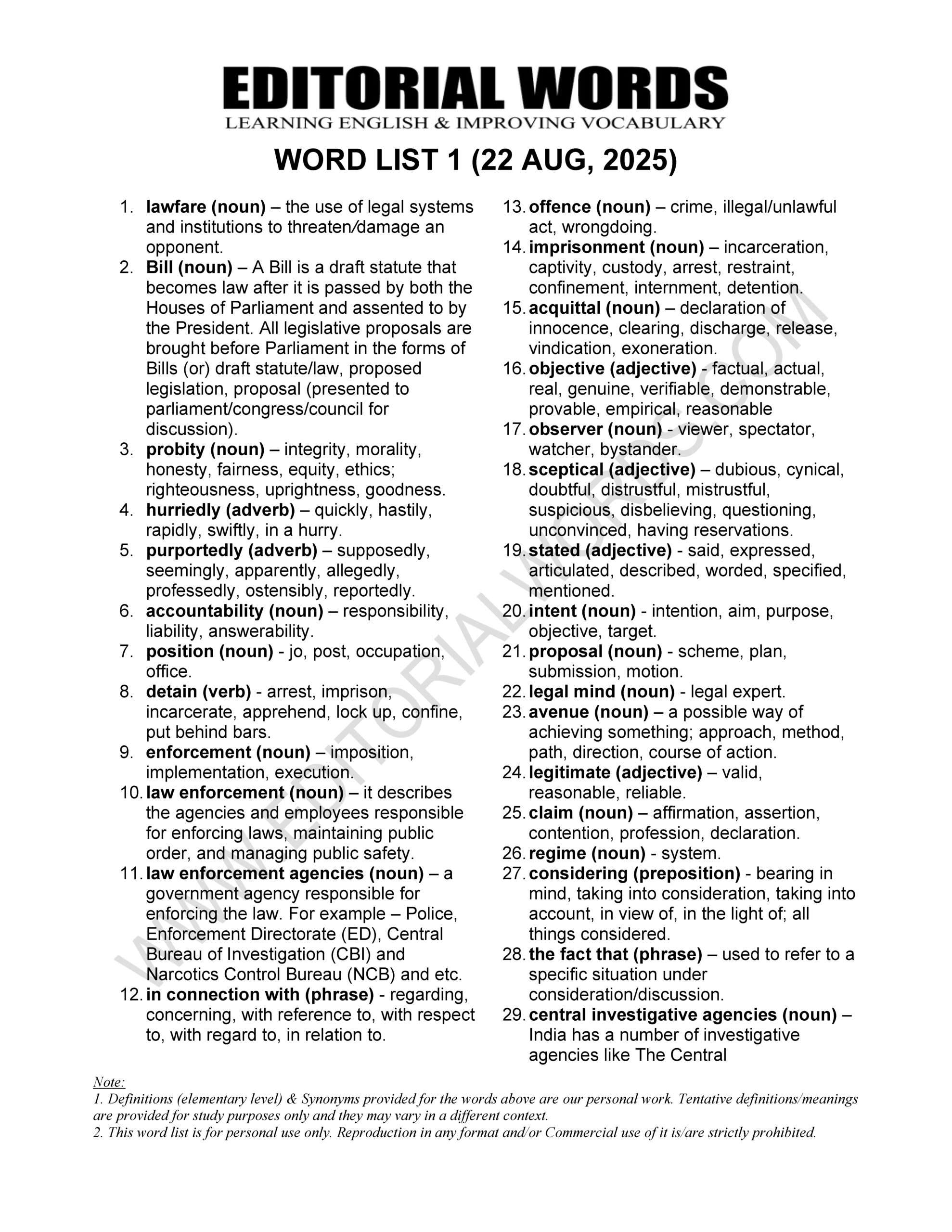
- lawfare (noun) – the use of legal systems and institutions to threaten/damage an opponent.
- Bill (noun) – A Bill is a draft statute that becomes law after it is passed by both the Houses of Parliament and assented to by the President. All legislative proposals are brought before Parliament in the forms of Bills (or) draft statute/law, proposed legislation, proposal (presented to parliament/congress/council for discussion).
- probity (noun) – integrity, morality, honesty, fairness, equity, ethics; righteousness, uprightness, goodness.
- hurriedly (adverb) – quickly, hastily, rapidly, swiftly, in a hurry.
- purportedly (adverb) – supposedly, seemingly, apparently, allegedly, professedly, ostensibly, reportedly.
- accountability (noun) – responsibility, liability, answerability.
- position (noun) – jo, post, occupation, office.
- detain (verb) – arrest, imprison, incarcerate, apprehend, lock up, confine, put behind bars.
- enforcement (noun) – imposition, implementation, execution.
- law enforcement (noun) – it describes the agencies and employees responsible for enforcing laws, maintaining public order, and managing public safety.
- law enforcement agencies (noun) – a government agency responsible for enforcing the law. For example – Police, Enforcement Directorate (ED), Central Bureau of Investigation (CBI) and Narcotics Control Bureau (NCB) and etc.
- in connection with (phrase) – regarding, concerning, with reference to, with respect to, with regard to, in relation to.
- offence (noun) – crime, illegal/unlawful act, wrongdoing.
- imprisonment (noun) – incarceration, captivity, custody, arrest, restraint, confinement, internment, detention.
- acquittal (noun) – declaration of innocence, clearing, discharge, release, vindication, exoneration.
- objective (adjective) – factual, actual, real, genuine, verifiable, demonstrable, provable, empirical, reasonable
- observer (noun) – viewer, spectator, watcher, bystander.
- sceptical (adjective) – dubious, cynical, doubtful, distrustful, mistrustful, suspicious, disbelieving, questioning, unconvinced, having reservations.
- stated (adjective) – said, expressed, articulated, described, worded, specified, mentioned.
- intent (noun) – intention, aim, purpose, objective, target.
- proposal (noun) – scheme, plan, submission, motion.
- legal mind (noun) – legal expert.
- avenue (noun) – a possible way of achieving something; approach, method, path, direction, course of action.
- legitimate (adjective) – valid, reasonable, reliable.
- claim (noun) – affirmation, assertion, contention, profession, declaration.
- regime (noun) – system.
- considering (preposition) – bearing in mind, taking into consideration, taking into account, in view of, in the light of; all things considered.
- the fact that (phrase) – used to refer to a specific situation under consideration/discussion.
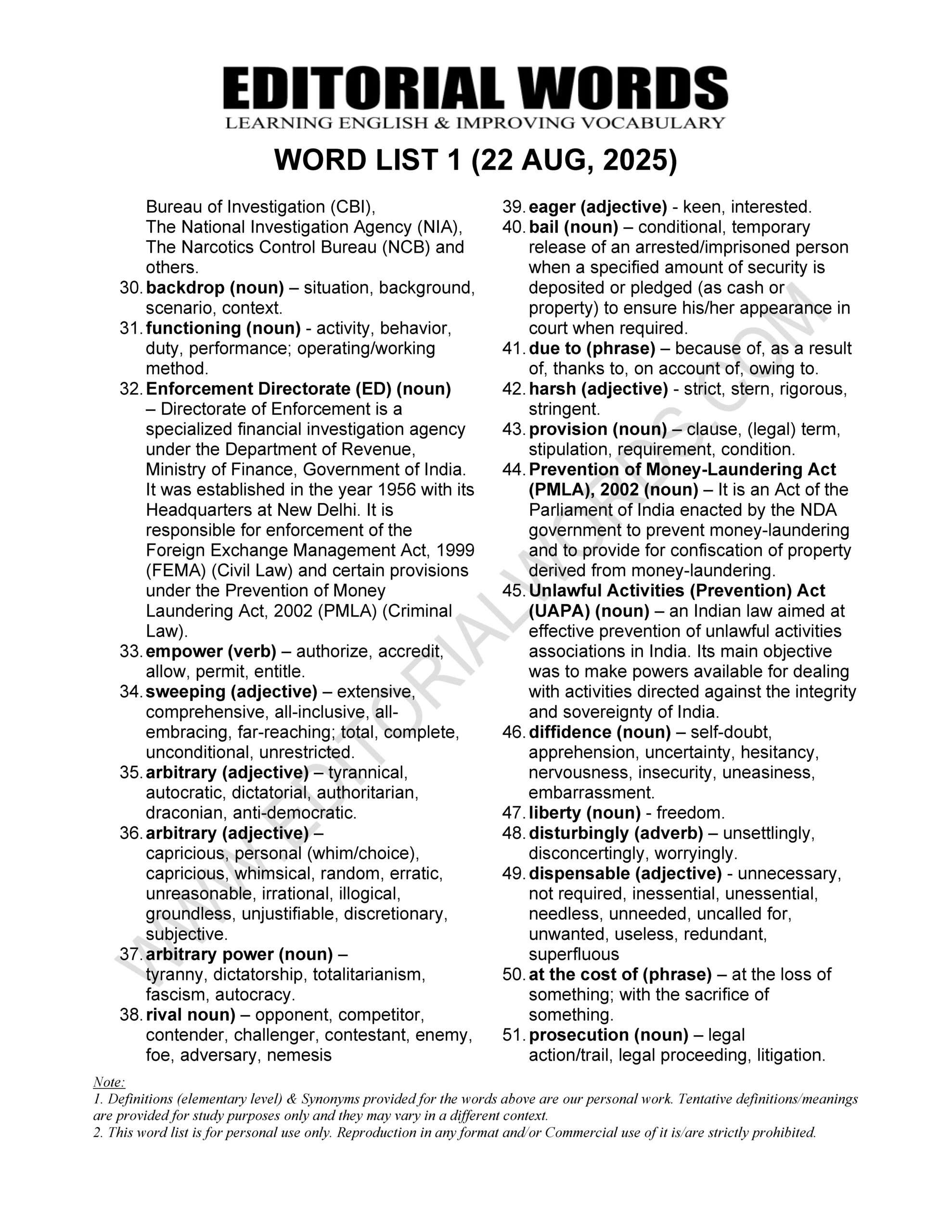
- central investigative agencies (noun) – India has a number of investigative agencies like The Central Bureau of Investigation (CBI), The National Investigation Agency (NIA), The Narcotics Control Bureau (NCB) and others.
- backdrop (noun) – situation, background, scenario, context.
- functioning (noun) – activity, behavior, duty, performance; operating/working method.
- Enforcement Directorate (ED) (noun) – Directorate of Enforcement is a specialized financial investigation agency under the Department of Revenue, Ministry of Finance, Government of India. It was established in the year 1956 with its Headquarters at New Delhi. It is responsible for enforcement of the Foreign Exchange Management Act, 1999 (FEMA) (Civil Law) and certain provisions under the Prevention of Money Laundering Act, 2002 (PMLA) (Criminal Law).
- empower (verb) – authorize, accredit, allow, permit, entitle.
- sweeping (adjective) – extensive, comprehensive, all-inclusive, all-embracing, far-reaching; total, complete, unconditional, unrestricted.
- arbitrary (adjective) – tyrannical, autocratic, dictatorial, authoritarian, draconian, anti-democratic.
- arbitrary (adjective) – capricious, personal (whim/choice), capricious, whimsical, random, erratic, unreasonable, irrational, illogical, groundless, unjustifiable, discretionary, subjective.
- arbitrary power (noun) – tyranny, dictatorship, totalitarianism, fascism, autocracy.
- rival noun) – opponent, competitor, contender, challenger, contestant, enemy, foe, adversary, nemesis
- eager (adjective) – keen, interested.
- bail (noun) – conditional, temporary release of an arrested/imprisoned person when a specified amount of security is deposited or pledged (as cash or property) to ensure his/her appearance in court when required.
- due to (phrase) – because of, as a result of, thanks to, on account of, owing to.
- harsh (adjective) – strict, stern, rigorous, stringent.
- provision (noun) – clause, (legal) term, stipulation, requirement, condition.
- Prevention of Money-Laundering Act (PMLA), 2002 (noun) – It is an Act of the Parliament of India enacted by the NDA government to prevent money-laundering and to provide for confiscation of property derived from money-laundering.
- Unlawful Activities (Prevention) Act (UAPA) (noun) – an Indian law aimed at effective prevention of unlawful activities associations in India. Its main objective was to make powers available for dealing with activities directed against the integrity and sovereignty of India.
- diffidence (noun) – self-doubt, apprehension, uncertainty, hesitancy, nervousness, insecurity, uneasiness, embarrassment.
- liberty (noun) – freedom.
- disturbingly (adverb) – unsettlingly, disconcertingly, worryingly.
- dispensable (adjective) – unnecessary, not required, inessential, unessential, needless, unneeded, uncalled for, unwanted, useless, redundant, superfluous
- at the cost of (phrase) – at the loss of something; with the sacrifice of something.
- prosecution (noun) – legal action/trail, legal proceeding, litigation.
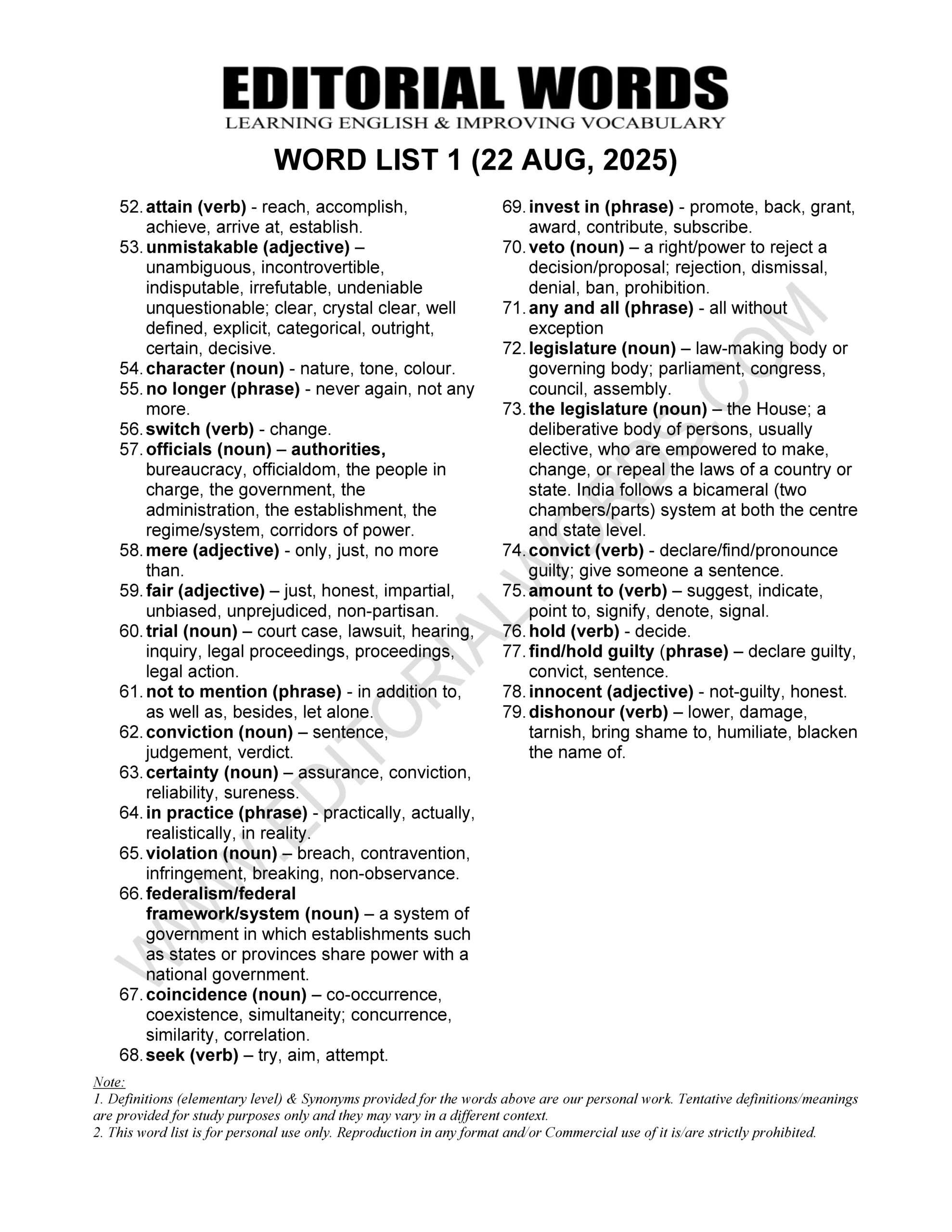
- attain (verb) – reach, accomplish, achieve, arrive at, establish.
- unmistakable (adjective) – unambiguous, incontrovertible, indisputable, irrefutable, undeniable unquestionable; clear, crystal clear, well defined, explicit, categorical, outright, certain, decisive.
- character (noun) – nature, tone, colour.
- no longer (phrase) – never again, not any more.
- switch (verb) – change.
- officials (noun) – authorities, bureaucracy, officialdom, the people in charge, the government, the administration, the establishment, the regime/system, corridors of power.
- mere (adjective) – only, just, no more than.
- fair (adjective) – just, honest, impartial, unbiased, unprejudiced, non-partisan.
- trial (noun) – court case, lawsuit, hearing, inquiry, legal proceedings, proceedings, legal action.
- not to mention (phrase) – in addition to, as well as, besides, let alone.
- conviction (noun) – sentence, judgement, verdict.
- certainty (noun) – assurance, conviction, reliability, sureness.
- in practice (phrase) – practically, actually, realistically, in reality.
- violation (noun) – breach, contravention, infringement, breaking, non-observance.
- federalism/federal framework/system (noun) – a system of government in which establishments such as states or provinces share power with a national government.
- coincidence (noun) – co-occurrence, coexistence, simultaneity; concurrence, similarity, correlation.
- seek (verb) – try, aim, attempt.
- invest in (phrase) – promote, back, grant, award, contribute, subscribe.
- veto (noun) – a right/power to reject a decision/proposal; rejection, dismissal, denial, ban, prohibition.
- any and all (phrase) – all without exception
- legislature (noun) – law-making body or governing body; parliament, congress, council, assembly.
- the legislature (noun) – the House; a deliberative body of persons, usually elective, who are empowered to make, change, or repeal the laws of a country or state. India follows a bicameral (two chambers/parts) system at both the centre and state level.
- convict (verb) – declare/find/pronounce guilty; give someone a sentence.
- amount to (verb) – suggest, indicate, point to, signify, denote, signal.
- hold (verb) – decide.
- find/hold guilty (phrase) – declare guilty, convict, sentence.
- innocent (adjective) – not-guilty, honest.
- dishonour (verb) – lower, damage, tarnish, bring shame to, humiliate, blacken the name of.
Note :
1. Click each one of the words above for their definition, more synonyms, pronunciation, example sentences, phrases, derivatives, origin and etc. from http://www.oxforddictionaries.com/.
2. Definitions (elementary level) & Synonyms provided for the words above are my personal work and not that of Oxford University Press. Tentative definitions/meanings are provided for study purposes only and they may vary in a different context.
3. This word list is for personal use only. Reproduction in any format and/or Commercial use of it is/are strictly prohibited.
The Hindu Editorial (Lawfare politics) – Aug 22, 2025:
“Idioms & Phrases” We Learnt Last Week
“Important Definitions” We Learnt Last Week
Recent Word Lists For The Hindu Editorial Articles
Three bills, including one for a constitutional amendment, introduced hurriedly by the Centre towards the end of the Parliament session, are purportedly meant to improve probity and accountability for the Prime Minister, Chief Ministers and Ministers… For further reading, visit “The Hindu”. Below is today’s word list-1 for The Hindu Editorial (Lawfare politics) – Aug 22, 2025.