

The Hindu Editorial (Interrupted growth) – Jul 30, 2025
To read this article, click “The Hindu”.
This preview is provided here with permission.
Courtesy: The Hindu
The Hindu Editorial (Interrupted growth) – Jul 30, 2025:
- tie (verb) – relate, connect, link.
- infrastructure (noun) – the basic physical or organisational structure or framework that a country or organization needs in order to function properly. For a whole nation, it includes all the physical systems such as buildings, roads & railways networks, utilities, etc.
- Index of Industrial Production (IIP) (noun) – a composite (combined/complex) indicator that measures the changes in the volume of production of a basket of industrial products during a given period with respect to the volume of production in a chosen base period.
- barometer (noun) – measure, index, indicator, criterion, gauge.
- largely (adverb) – mainly, mostly, completely, entirely, wholly.
- due to (phrase) – because of, owing to, on account of, as a result of.
- contraction (noun) – In economics, it refers to a decline in national output as measured by gross domestic product.
- onset (noun) – start, beginning, arrival.
- erratic (adjective) – unpredictable, turbulent, changeable, inconstant, inconsistent, volatile, uncertain.
- uneven (adjective) – inconsistent, varying, changeable, fluctuating, irregular, patchy.
- led past participle of lead to (verb) – result in, cause, bring on, bring about, give rise to.
- waterlogging (noun) – a form of natural flooding when underground water rises to surface level as the result of over-irrigation. Waterlogging can displace the spoil, affect the natural processes in the soil, and result in a build-up of toxic substances in the soil, which can impede plant growth in the immediate area.
- belt (noun) – area, region, stretch, tract, swathe.
- hamper (verb) – obstruct, impede, hold up, slow down, thwart, inhibit, restrict.
- key (adjective) – vital, main, major, important, crucial, essential, central.
- meteorological (adjective) – relating to the branch of science that deals with phenomena (events) of the atmosphere or weather.
- categorise (verb) – classify, group, designate, list.
- deficient (adjective) – insufficient, inadequate, meagre, poor.
- resultant (adjective) – following, ensuing, eventual, subsequent.
- disruption (noun) – disturbance, obstruction.
- supply chain (noun) – a dynamic network when a company purchases or uses goods or services from others. It involves people, information, processes, and resources involved in the production, handling, and distribution of materials and finished products or providing a service to the customer.
- sluggish (adjective) – slow, slow-moving, inactive, lethargic, unresponsive, dull.
- up from (phrase) – an increase or rise from a previous point or level.
- in turn (phrase) – in succession; successively.
- likely (adverb) – probably, presumably, doubtlessly.
- subdued (adjective) – diminished, lessened, reduced, decreased, controlled, contained, moderated; low-key, restrained, toned down, muted.
- make up for (phrasal verb) – constitute, account for, comprise, form.
- quarter (noun) – a period of three months (considered as one-fourth of a year).
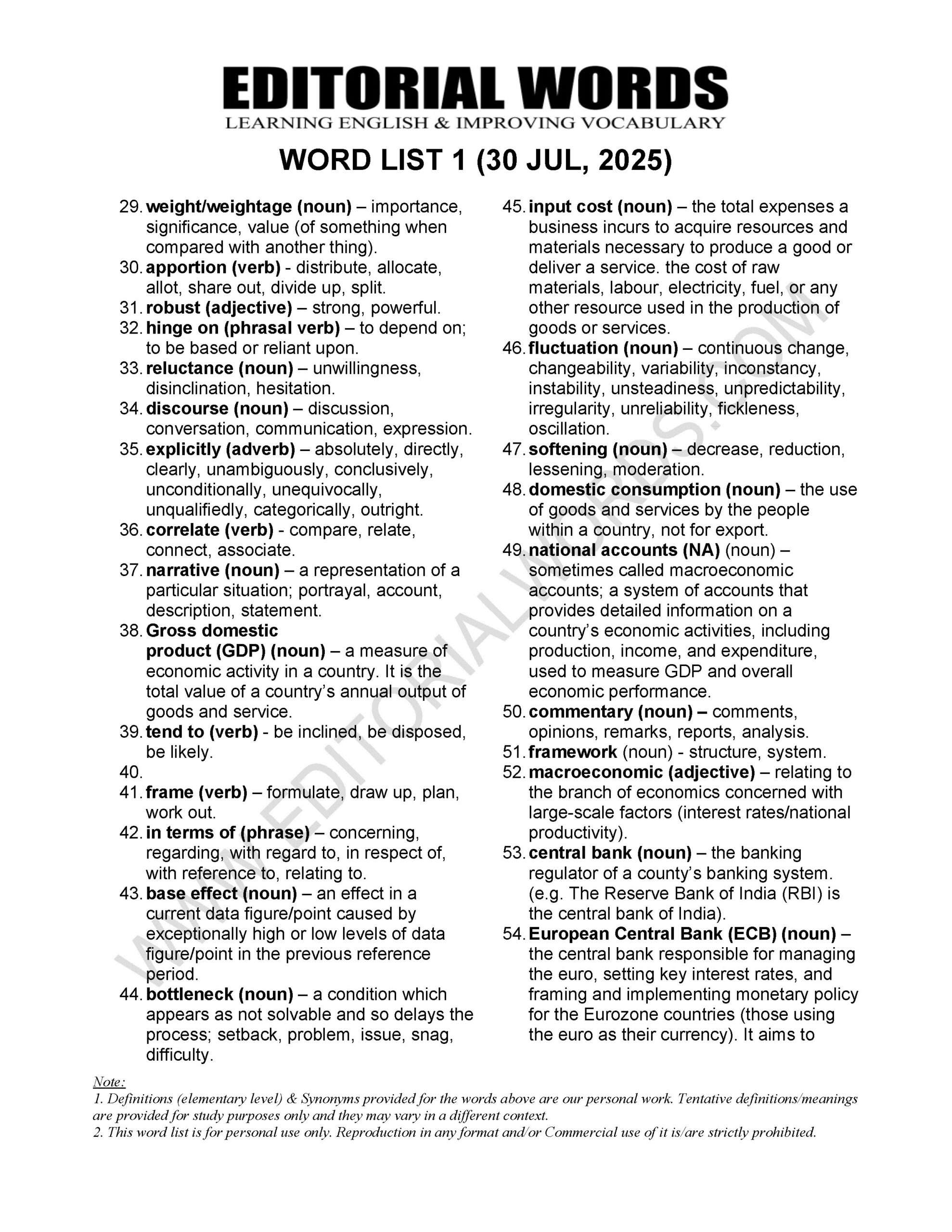
- weight/weightage (noun) – importance, significance, value (of something when compared with another thing).
- apportion (verb) – distribute, allocate, allot, share out, divide up, split.
- robust (adjective) – strong, powerful.
- hinge on (phrasal verb) – to depend on; to be based or reliant upon.
- reluctance (noun) – unwillingness, disinclination, hesitation.
- discourse (noun) – discussion, conversation, communication, expression.
- explicitly (adverb) – absolutely, directly, clearly, unambiguously, conclusively, unconditionally, unequivocally, unqualifiedly, categorically, outright.
- correlate (verb) – compare, relate, connect, associate.
- narrative (noun) – a representation of a particular situation; portrayal, account, description, statement.
- Gross domestic product (GDP) (noun) – a measure of economic activity in a country. It is the total value of a country’s annual output of goods and service.
- tend to (verb) – be inclined, be disposed, be likely.
- frame (verb) – formulate, draw up, plan, work out.
- in terms of (phrase) – concerning, regarding, with regard to, in respect of, with reference to, relating to.
- base effect (noun) – an effect in a current data figure/point caused by exceptionally high or low levels of data figure/point in the previous reference period.
- bottleneck (noun) – a condition which appears as not solvable and so delays the process; setback, problem, issue, snag, difficulty.
- input cost (noun) – the total expenses a business incurs to acquire resources and materials necessary to produce a good or deliver a service. the cost of raw materials, labour, electricity, fuel, or any other resource used in the production of goods or services.
- fluctuation (noun) – continuous change, changeability, variability, inconstancy, instability, unsteadiness, unpredictability, irregularity, unreliability, fickleness, oscillation.
- softening (noun) – decrease, reduction, lessening, moderation.
- domestic consumption (noun) – the use of goods and services by the people within a country, not for export.
- national accounts (NA) (noun) – sometimes called macroeconomic accounts; a system of accounts that provides detailed information on a country’s economic activities, including production, income, and expenditure, used to measure GDP and overall economic performance.
- commentary (noun) – comments, opinions, remarks, reports, analysis.
- framework (noun) – structure, system.
- macroeconomic (adjective) – relating to the branch of economics concerned with large-scale factors (interest rates/national productivity).
- central bank (noun) – the banking regulator of a county’s banking system. (e.g. The Reserve Bank of India (RBI) is the central bank of India).
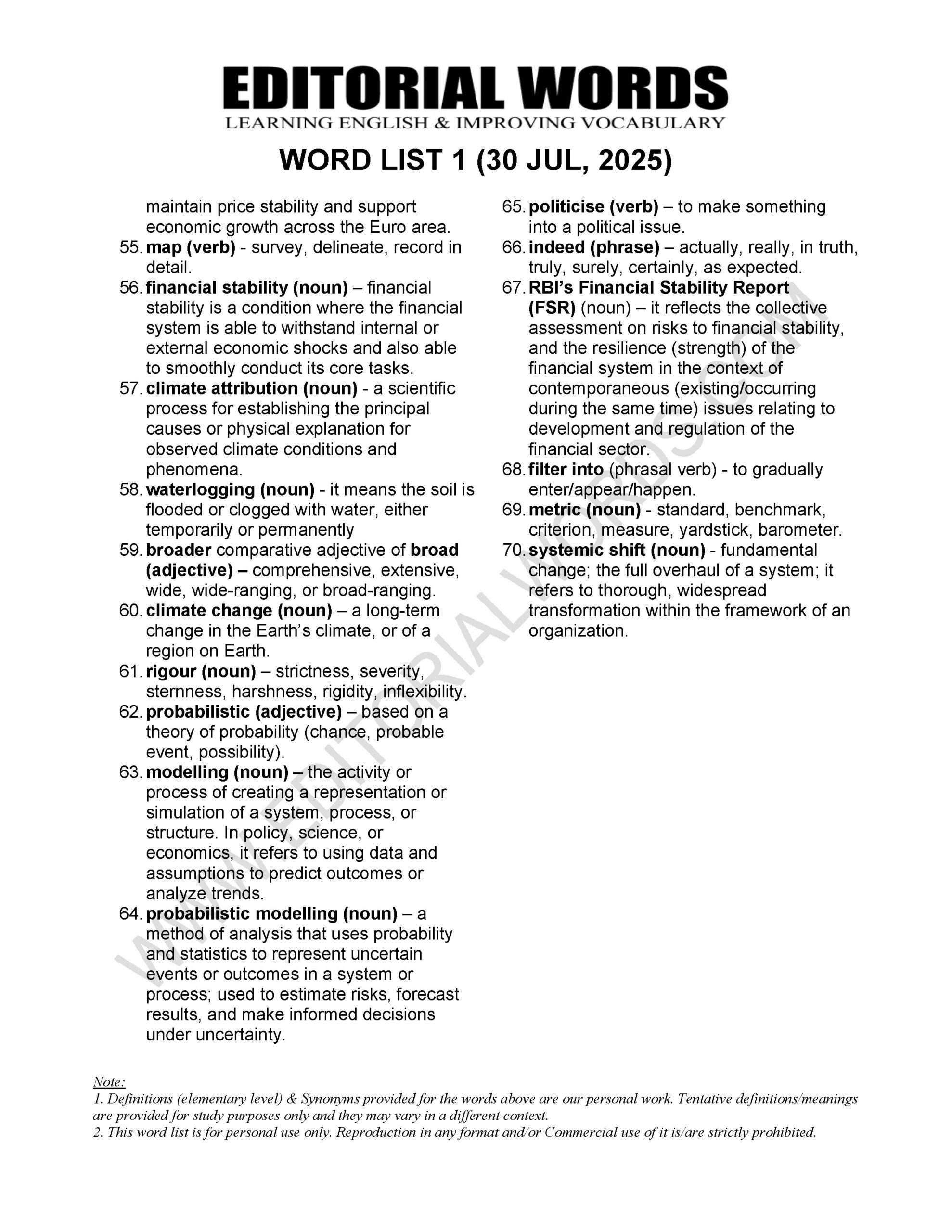
- European Central Bank (ECB) (noun) – the central bank responsible for managing the euro, setting key interest rates, and framing and implementing monetary policy for the Eurozone countries (those using the euro as their currency). It aims to maintain price stability and support economic growth across the Euro area.
- map (verb) – survey, delineate, record in detail.
- financial stability (noun) – financial stability is a condition where the financial system is able to withstand internal or external economic shocks and also able to smoothly conduct its core tasks.
- climate attribution (noun) – a scientific process for establishing the principal causes or physical explanation for observed climate conditions and phenomena.
- waterlogging (noun) – it means the soil is flooded or clogged with water, either temporarily or permanently
- broader comparative adjective of broad (adjective) – comprehensive, extensive, wide, wide-ranging, or broad-ranging.
- climate change (noun) – a long-term change in the Earth’s climate, or of a region on Earth.
- rigour (noun) – strictness, severity, sternness, harshness, rigidity, inflexibility.
- probabilistic (adjective) – based on a theory of probability (chance, probable event, possibility).
- modelling (noun) – the activity or process of creating a representation or simulation of a system, process, or structure. In policy, science, or economics, it refers to using data and assumptions to predict outcomes or analyze trends.
- probabilistic modelling (noun) – a method of analysis that uses probability and statistics to represent uncertain events or outcomes in a system or process; used to estimate risks, forecast results, and make informed decisions under uncertainty.
- politicise (verb) – to make something into a political issue.
- indeed (phrase) – actually, really, in truth, truly, surely, certainly, as expected.
- RBI’s Financial Stability Report (FSR) (noun) – it reflects the collective assessment on risks to financial stability, and the resilience (strength) of the financial system in the context of contemporaneous (existing/occurring during the same time) issues relating to development and regulation of the financial sector.
- filter into (phrasal verb) – to gradually enter/appear/happen.
- metric (noun) – standard, benchmark, criterion, measure, yardstick, barometer.
- systemic shift (noun) – fundamental change; the full overhaul of a system; it refers to thorough, widespread transformation within the framework of an organization.
Note :
1. Click each one of the words above for their definition, more synonyms, pronunciation, example sentences, phrases, derivatives, origin and etc. from http://www.oxforddictionaries.com/.
2. Definitions (elementary level) & Synonyms provided for the words above are my personal work and not that of Oxford University Press. Tentative definitions/meanings are provided for study purposes only and they may vary in a different context.
3. This word list is for personal use only. Reproduction in any format and/or Commercial use of it is/are strictly prohibited.
The Hindu Editorial (Interrupted growth) – Jul 30, 2025:


“Idioms & Phrases” We Learnt Last Week
“Important Definitions” We Learnt Last Week
Recent Word Lists For The Hindu Editorial Articles
The Index of Industrial Production (IIP), the nation’s monthly barometer of goods output, revealed a 10-month low growth rate in June, at 1.5%, largely due to the sharp contraction in mining activity, by –8.7% (10.3% in June 2024), and… For further reading, visit “The Hindu”. Below is today’s word list-1 for The Hindu Editorial (Interrupted growth) – Jul 30, 2025.