
The Hindu Editorial (Danger of thought) – Jul 24, 2025
To read this article, click “The Hindu”.
This preview is provided here with permission.
Courtesy: The Hindu
The Hindu Editorial (Danger of thought) – Jul 24, 2025:
- The Maharashtra Special Public Security (MSPS) Bill, 2024 (noun) – it is to provide for more effective prevention of certain unlawful activities of individuals and organizations and for matters connected therewith or incidental thereto. The Bill seeks to provide for effective prevention of certain activities of individuals or organisations. These include any action or speech that constitutes danger to public order, incites violence, disrupts communication, or encourages disobedience to established law and its institutions.
- Bill (noun) – A Bill is a draft statute that becomes law after it is passed by both the Houses of Parliament and assented to by the President. All legislative proposals are brought before Parliament in the forms of Bills (or) draft statute/law, proposed legislation, proposal (presented to parliament/congress/council for discussion).
- endanger (verb) – threaten, jeopardize, imperil, put at risk, be detrimental to.
- open society (noun) – An open society is one that values individual freedom, promotes democratic governance, and allows for the free exchange of ideas and information. It is a society that recognizes and respects the inherent worth and dignity of every individual, regardless of their background, race, ethnicity, religion, or sexual orientation.
- disturbing (adjective) – discouraging, depressing, distressing, disquieting, disheartening.
- the executive (noun) – the executive is a branch of government which enforces the law as written by the legislature and interpreted by the judiciary.
- overreach (noun) – an act of trying to do too much or overdoing something.
- in the name of (phrase) – for the sake of, at the behest of, for the reason of.
- opponent (noun) – rival, adversary, contender, competitor.
- critic (noun) – criticizer, censurer, castigator, attacker, fault-finder.
- commentator (noun) – reporter, correspondent, journalist, anchor.
- charge (noun) – accusation, allegation.
- vague (adjective) – imprecise, inexact, unclear/uncertain.
- sweeping (adjective) – extensive, expansive, boundless, unconditional, unrestricted, exhaustive, comprehensive, all-inclusive, all-embracing, far-reaching.
- given (preposition) – considering, taking into account, bearing in mind.
- move (noun) – a proposal or presentation of a motion, bill, amendment, resolution, or question for consideration.
- move (noun) – action, activity, measure, step.
- criminalise (verb) – make something (an activity) illegal.
- portend (verb) – indicate, herald, foretell, augur, signal, signify, bode (ill), point to (particularly a bad outcome).
- undermine (verb) – to weaken something gradually or secretly, making it less effective or successful; weaken, erode, subvert, sabotage.
- constitutional order (noun) – a reasonably stable set of institutions through which a nation’s fundamental decisions are made over a sustained period, and the principles that guide those decisions; put simply, the constitutional order is the combination of institutions and principles.
- possibility (noun) – chance, likelihood, probability.
- indeed (phrase) – actually, really, in truth, truly, surely, certainly, as expected.
- misuse (noun) – misapplication, exploitation, wrong use, illegal use.
- apparent (adjective) – evident, clear, visible, noticeable, recognizable, flagrant, glaring, obvious, pronounced.
- seek (verb) – try, aim, attempt.
- Maoist (noun) – a follower of Maoism (Maoism is a form of communism developed by Mao Tse Tung. It is a doctrine to capture State power through a combination of armed insurgency, mass mobilization and strategic alliances). The largest and the most violent Maoist formation in India is the Communist Party of India (Maoist).
- brainwash (verb) – affect, sway, control, convince, persuade, talk around, prevail on, intimidate, brainwash.
- front organisation (noun) – any entity set up as the face/front of another organization or group.
- await (verb) – wait for.
- assent (noun) – approval, agreement, acceptance, consent, concurrence.
- come into force (phrase) – effective, operative, in operation, in action, valid.
- suspect (adjective) – suspicious, dubious, doubtful, under suspicion.
- offence (noun) – crime, illegal act, breach of the law, violation of the law, wrongdoing, act of misconduct, misdeed.
- fundraise (verb) – seek financial support for a cause; to collect money for a purpose.
- front (noun) – an organized political group; front line, vanguard.
- broadly (adverb) – in general, loosely, roughly, approximately.
- among other things (phrase) – used to indicate that there are several more things like the one mentioned, but that you do not intend to mention them all.
- representation (noun) – portrayal, depiction, characterization, description.
- constitute (verb) – amount to, account for, compose, comprise, make up.
- menace (noun) – threat/danger, risk/peril, intimidation.
- public order (noun) – it is essentially the absence of disorder – the quiet and orderly behaviour of people in public space. It involves people behaving sensibly and rationally, and respecting others.
- public order (noun) – it means the situation that exists when people obey the laws, rules or authority of the State.
- tranquility (noun) – peacefulness, restfulness, calmness, quietness.
- cognisable offence/crime (noun) – an offence for which, a police officer without any warrant has authority to arrest and to start an investigation with or without the permission of a court.
- non-cognisable offence (noun) – an offence for which, a police officer without any warrant has no authority to arrest.
- the accused (noun) – the suspected person.
- warrant (noun) – authorization, permission, consent, sanction.
- arrest warrant (noun) – It is a written order issued by a Court to a police officer to arrest and produce an offender or to search his premises for a particular thing.
- term (noun) – prison term, sentence, jail sentence, punishment.
- Naxal/Naxalite (noun) – Deriving its name from the Naxalbari village of West Bengal, Naxals or Naxalites are members of the Communist Party of India-Maoists (CPI-Maoist), classified under the banned LWE (Left Wing Extremism) groups.
- frontal (adjective) – at the front/front part/front line.
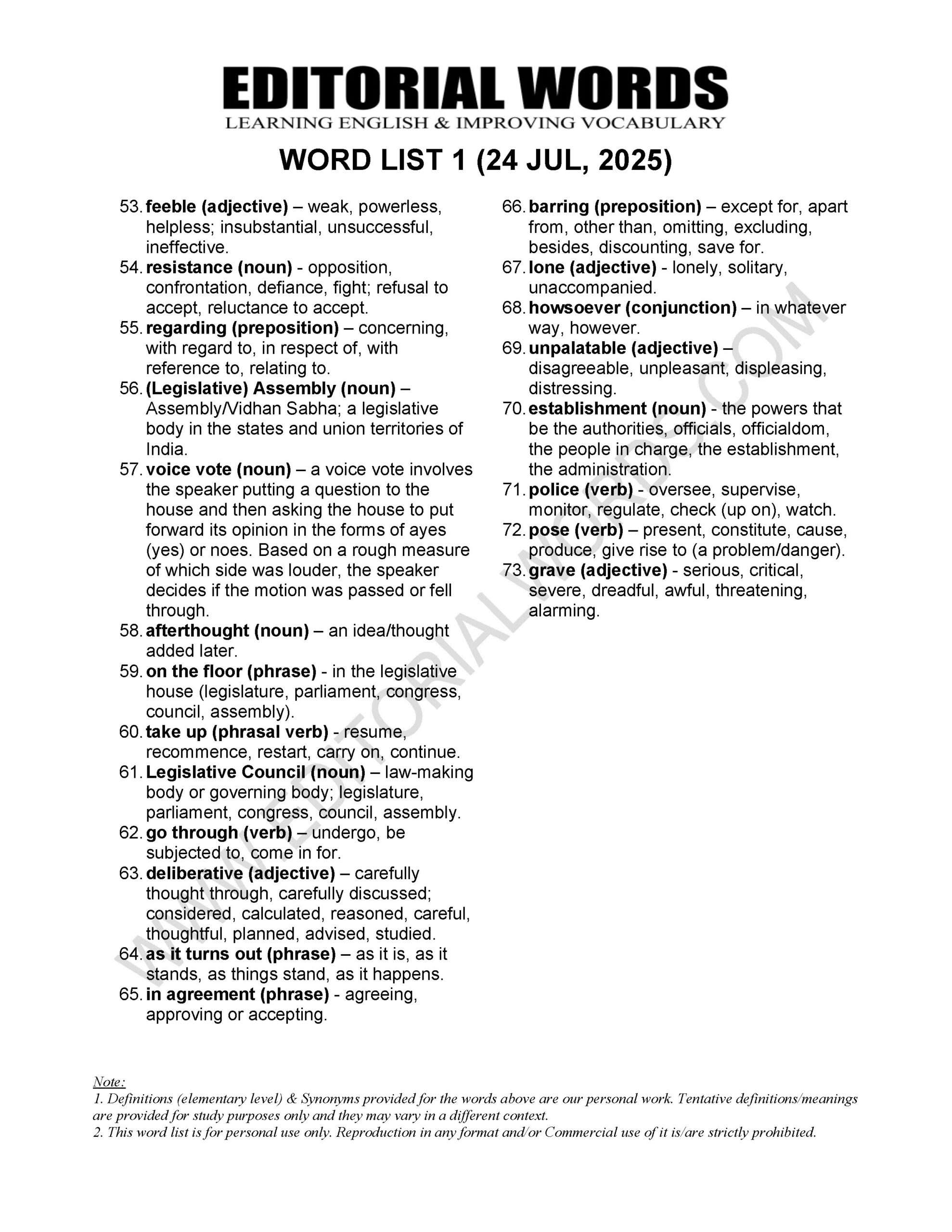
- feeble (adjective) – weak, powerless, helpless; insubstantial, unsuccessful, ineffective.
- resistance (noun) – opposition, confrontation, defiance, fight; refusal to accept, reluctance to accept.
- regarding (preposition) – concerning, with regard to, in respect of, with reference to, relating to.
- (Legislative) Assembly (noun) – Assembly/Vidhan Sabha; a legislative body in the states and union territories of India.
- voice vote (noun) – a voice vote involves the speaker putting a question to the house and then asking the house to put forward its opinion in the forms of ayes (yes) or noes. Based on a rough measure of which side was louder, the speaker decides if the motion was passed or fell through.
- afterthought (noun) – an idea/thought added later.
- on the floor (phrase) – in the legislative house (legislature, parliament, congress, council, assembly).
- take up (phrasal verb) – resume, recommence, restart, carry on, continue.
- Legislative Council (noun) – law-making body or governing body; legislature, parliament, congress, council, assembly.
- go through (verb) – undergo, be subjected to, come in for.
- deliberative (adjective) – carefully thought through, carefully discussed; considered, calculated, reasoned, careful, thoughtful, planned, advised, studied.
- as it turns out (phrase) – as it is, as it stands, as things stand, as it happens.
- in agreement (phrase) – agreeing, approving or accepting.
- barring (preposition) – except for, apart from, other than, omitting, excluding, besides, discounting, save for.
- lone (adjective) – lonely, solitary, unaccompanied.
- howsoever (conjunction) – in whatever way, however.
- unpalatable (adjective) – disagreeable, unpleasant, displeasing, distressing.
- establishment (noun) – the powers that be the authorities, officials, officialdom, the people in charge, the establishment, the administration.
- police (verb) – oversee, supervise, monitor, regulate, check (up on), watch.
- pose (verb) – present, constitute, cause, produce, give rise to (a problem/danger).
- grave (adjective) – serious, critical, severe, dreadful, awful, threatening, alarming.
Note :
1. Click each one of the words above for their definition, more synonyms, pronunciation, example sentences, phrases, derivatives, origin and etc. from http://www.oxforddictionaries.com/.
2. Definitions (elementary level) & Synonyms provided for the words above are my personal work and not that of Oxford University Press. Tentative definitions/meanings are provided for study purposes only and they may vary in a different context.
3. This word list is for personal use only. Reproduction in any format and/or Commercial use of it is/are strictly prohibited.
The Hindu Editorial (Danger of thought) – Jul 24, 2025:


“Idioms & Phrases” We Learnt Last Week
“Important Definitions” We Learnt Last Week
Recent Word Lists For The Hindu Editorial Articles
The Maharashtra Special Public Security (MSPS) Bill, 2024 follows the disturbing pattern of executive overreach in the name of security. Existing laws are often misused against political opponents and critics of the ruling party, including commentators… For further reading, visit “The Hindu”. Below is today’s word list-2 for The Hindu Editorial (Danger of thought) – Jul 24, 2025.