
The Hindu Editorial (Arrest and unrest) – Jul 31, 2025
To read this article, click “The Hindu”.
This preview is provided here with permission.
Courtesy: The Hindu
The Hindu Editorial (Arrest and unrest) – Jul 31, 2025:
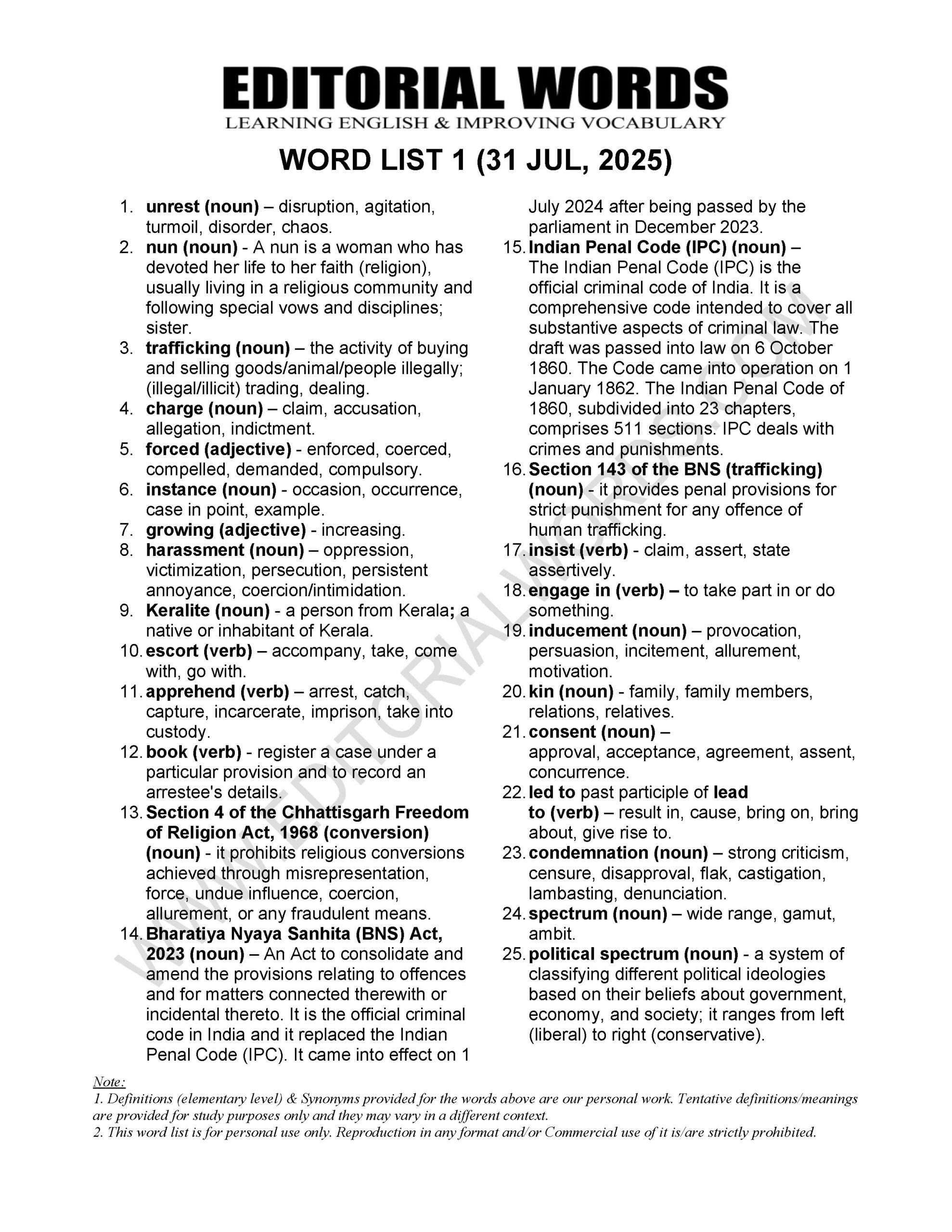
- unrest (noun) – disruption, agitation, turmoil, disorder, chaos.
- nun (noun) – A nun is a woman who has devoted her life to her faith (religion), usually living in a religious community and following special vows and disciplines; sister.
- trafficking (noun) – the activity of buying and selling goods/animal/people illegally; (illegal/illicit) trading, dealing.
- charge (noun) – claim, accusation, allegation, indictment.
- forced (adjective) – enforced, coerced, compelled, demanded, compulsory.
- instance (noun) – occasion, occurrence, case in point, example.
- growing (adjective) – increasing.
- harassment (noun) – oppression, victimization, persecution, persistent annoyance, coercion/intimidation.
- Keralite (noun) – a person from Kerala; a native or inhabitant of Kerala.
- escort (verb) – accompany, take, come with, go with.
- apprehend (verb) – arrest, catch, capture, incarcerate, imprison, take into custody.
- book (verb) – register a case under a particular provision and to record an arrestee’s details.
- Section 4 of the Chhattisgarh Freedom of Religion Act, 1968 (conversion) (noun) – it prohibits religious conversions achieved through misrepresentation, force, undue influence, coercion, allurement, or any fraudulent means.
- Bharatiya Nyaya Sanhita (BNS) Act, 2023 (noun) – An Act to consolidate and amend the provisions relating to offences and for matters connected therewith or incidental thereto. It is the official criminal code in India and it replaced the Indian Penal Code (IPC). It came into effect on 1 July 2024 after being passed by the parliament in December 2023.
- Indian Penal Code (IPC) (noun) – The Indian Penal Code (IPC) is the official criminal code of India. It is a comprehensive code intended to cover all substantive aspects of criminal law. The draft was passed into law on 6 October 1860. The Code came into operation on 1 January 1862. The Indian Penal Code of 1860, subdivided into 23 chapters, comprises 511 sections. IPC deals with crimes and punishments.
- Section 143 of the BNS (trafficking) (noun) – it provides penal provisions for strict punishment for any offence of human trafficking.
- insist (verb) – claim, assert, state assertively.
- engage in (verb) – to take part in or do something.
- inducement (noun) – provocation, persuasion, incitement, allurement, motivation .
- kin (noun) – family, family members, relations, relatives.
- consent (noun) – approval, acceptance, agreement, assent, concurrence.
- led to past participle of lead to (verb) – result in, cause, bring on, bring about, give rise to.
- condemnation (noun) – strong criticism, censure, disapproval, flak, castigation, lambasting, denunciation.
- spectrum (noun) – wide range, gamut, ambit.
- political spectrum (noun) – a system of classifying different political ideologies based on their beliefs about government, economy, and society; it ranges from left (liberal) to right (conservative).
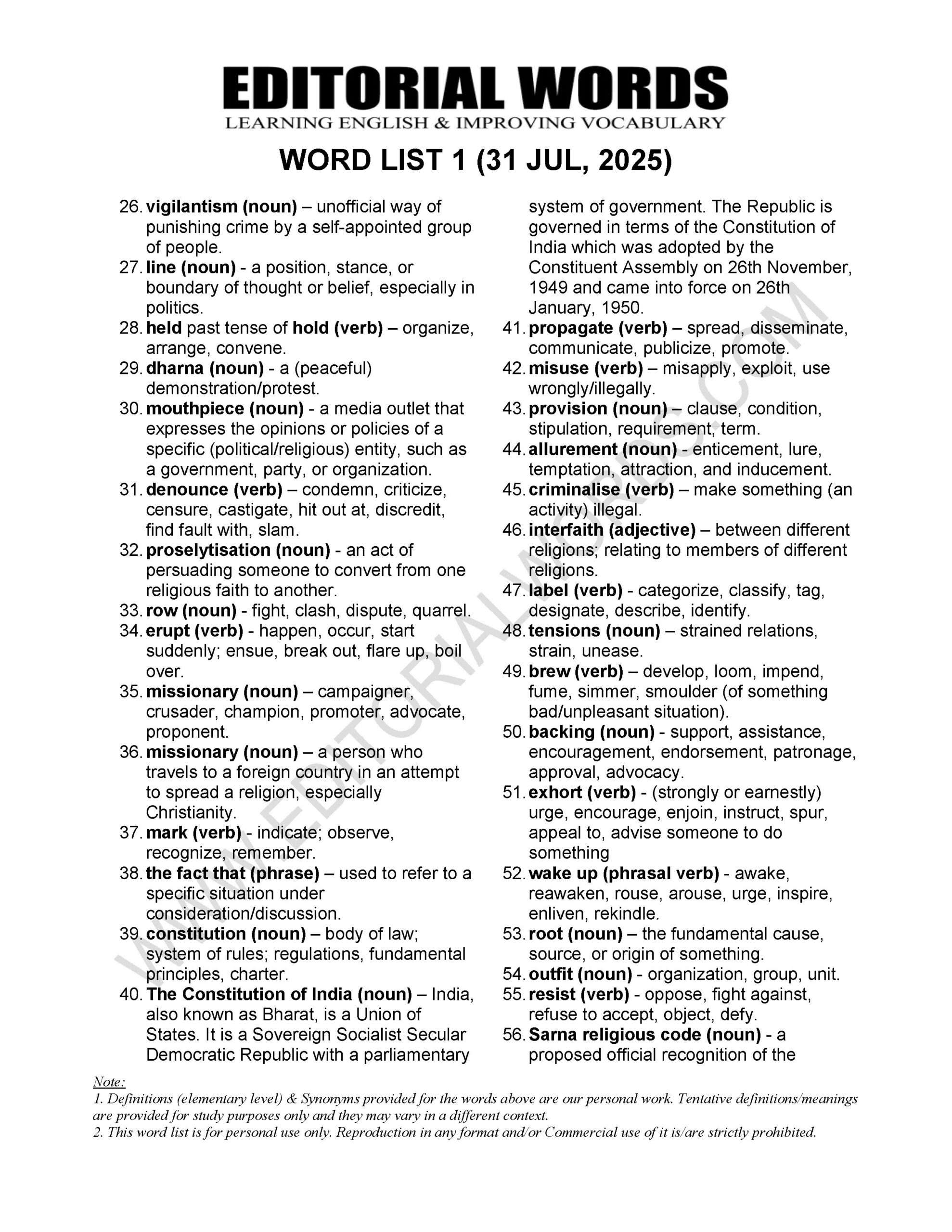
- vigilantism (noun) – unofficial way of punishing crime by a self-appointed group of people.
- line (noun) – a position, stance, or boundary of thought or belief, especially in politics.
- held past tense of hold (verb) – organize, arrange, convene.
- dharna (noun) – a (peaceful) demonstration/protest.
- mouthpiece (noun) – a media outlet that expresses the opinions or policies of a specific (political/religious) entity, such as a government, party, or organization.
- denounce (verb) – condemn, criticize, censure, castigate, hit out at, discredit, find fault with, slam.
- proselytisation (noun) – an act of persuading someone to convert from one religious faith to another.
- row (noun) – fight, clash, dispute, quarrel.
- erupt (verb) – happen, occur, start suddenly; ensue, break out, flare up, boil over.
- missionary (noun) – campaigner, crusader, champion, promoter, advocate, proponent.
- missionary (noun) – a person who travels to a foreign country in an attempt to spread a religion, especially Christianity.
- mark (verb) – indicate; observe, recognize, remember.
- the fact that (phrase) – used to refer to a specific situation under consideration/discussion.
- constitution (noun) – body of law; system of rules; regulations, fundamental principles, charter.
- The Constitution of India (noun) – India, also known as Bharat, is a Union of States. It is a Sovereign Socialist Secular Democratic Republic with a parliamentary system of government. The Republic is governed in terms of the Constitution of India which was adopted by the Constituent Assembly on 26th November, 1949 and came into force on 26th January, 1950.
- propagate (verb) – spread, disseminate, communicate, publicize, promote.
- misuse (verb) – misapply, exploit, use wrongly/illegally.
- provision (noun) – clause, condition, stipulation, requirement, term.
- allurement (noun) – enticement, lure, temptation, attraction, and inducement.
- criminalise (verb) – make something (an activity) illegal.
- interfaith (adjective) – between different religions; relating to members of different religions.
- label (verb) – categorize, classify, tag, designate, describe, identify.
- tensions (noun) – strained relations, strain, unease.
- brew (verb) – develop, loom, impend, fume, simmer, smoulder (of something bad/unpleasant situation).
- backing (noun) – support, assistance, encouragement, endorsement, patronage, approval, advocacy.
- exhort (verb) – (strongly or earnestly) urge, encourage, enjoin, instruct, spur, appeal to, advise someone to do something
- wake up (phrasal verb) – awake, reawaken, rouse, arouse, urge, inspire, enliven, rekindle.
- root (noun) – the fundamental cause, source, or origin of something.
- outfit (noun) – organization, group, unit.
- resist (verb) – oppose, fight against, refuse to accept, object, defy.
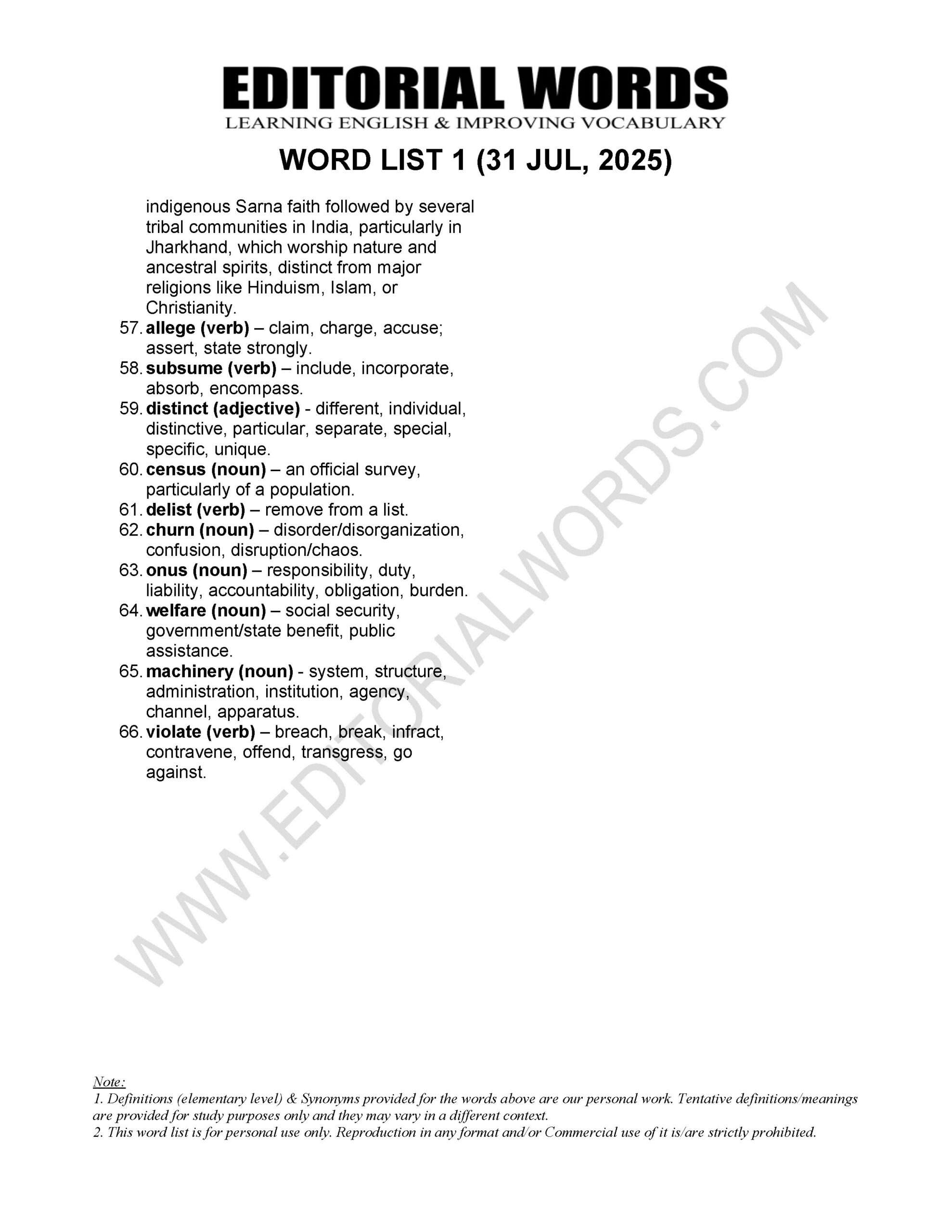
- Sarna religious code (noun) – a proposed official recognition of the indigenous Sarna faith followed by several tribal communities in India, particularly in Jharkhand, which worship nature and ancestral spirits, distinct from major religions like Hinduism, Islam, or Christianity.
- allege (verb) – claim, charge, accuse; assert, state strongly.
- subsume (verb) – include, incorporate, absorb, encompass.
- distinct (adjective) – different, individual, distinctive, particular, separate, special, specific, unique.
- census (noun) – an official survey, particularly of a population.
- delist (verb) – remove from a list.
- churn (noun) – disorder/disorganization, confusion, disruption/chaos.
- onus (noun) – responsibility, duty, liability, accountability, obligation, burden.
- welfare (noun) – social security, government/state benefit, public assistance.
- machinery (noun) – system, structure, administration, institution, agency, channel, apparatus.
- violate (verb) – breach, break, infract, contravene, offend, transgress, go against.
Note :
1. Click each one of the words above for their definition, more synonyms, pronunciation, example sentences, phrases, derivatives, origin and etc. from http://www.oxforddictionaries.com/.
2. Definitions (elementary level) & Synonyms provided for the words above are my personal work and not that of Oxford University Press. Tentative definitions/meanings are provided for study purposes only and they may vary in a different context.
3. This word list is for personal use only. Reproduction in any format and/or Commercial use of it is/are strictly prohibited.
The Hindu Editorial (Arrest and unrest) – Jul 31, 2025:
“Idioms & Phrases” We Learnt Last Week
“Important Definitions” We Learnt Last Week
Recent Word Lists For The Hindu Editorial Articles
The arrest of two Catholic nuns by the Chhattisgarh police on charges of human trafficking and forced conversion is another instance of growing religion-related harassment… For further reading, visit “The Hindu”. Below is today’s word list-1 for The Hindu Editorial (Arrest and unrest) – Jul 31, 2025.