
The Hindu Editorial (New reality) – Mar 03, 2026
To read this article, click “The Hindu”.
This preview is provided here with permission.
Courtesy: The Hindu
The Hindu Editorial (New reality) – Mar 03, 2026:
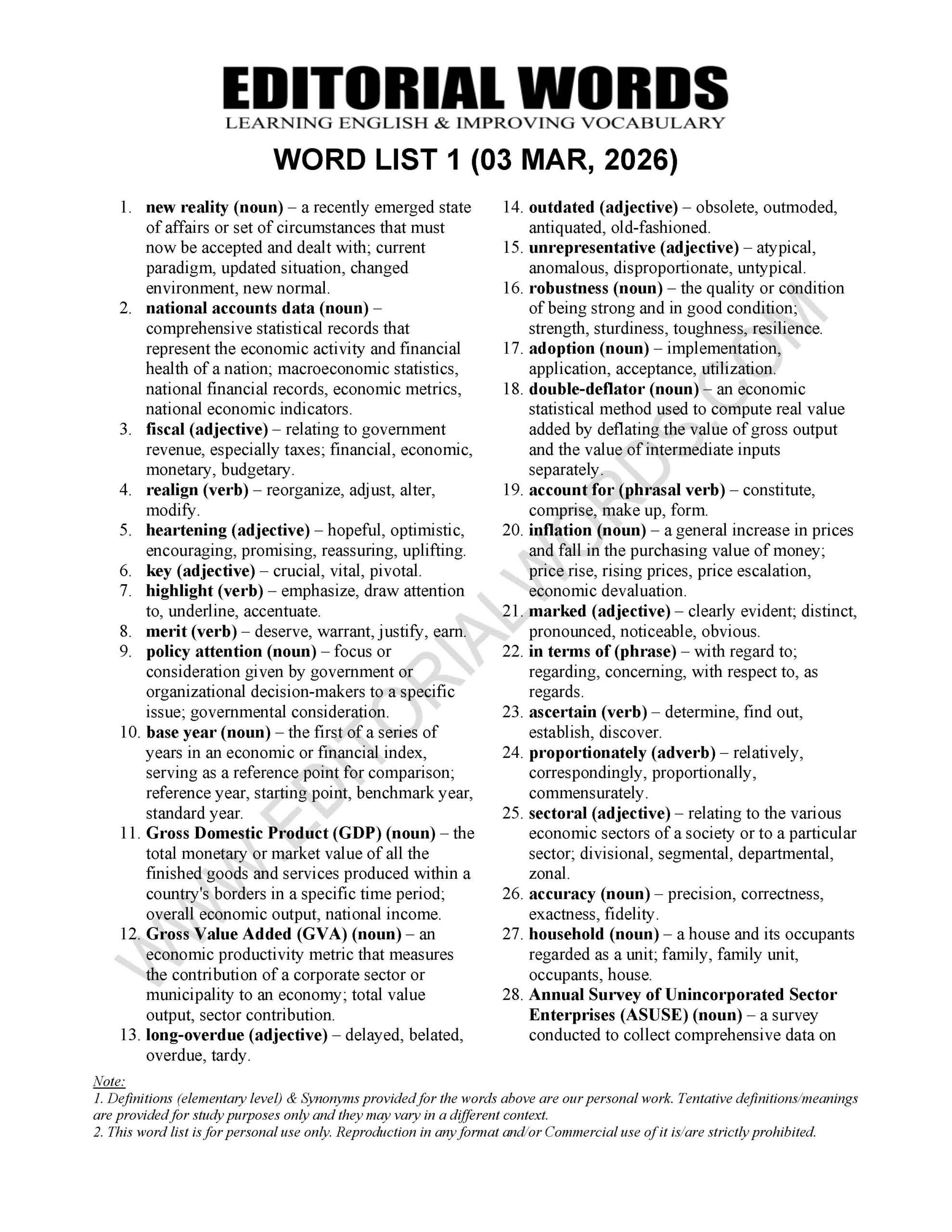
- new reality (noun) – a recently emerged state of affairs or set of circumstances that must now be accepted and dealt with; current paradigm, updated situation, changed environment, new normal.
- national accounts data (noun) – comprehensive statistical records that represent the economic activity and financial health of a nation; macroeconomic statistics, national financial records, economic metrics, national economic indicators.
- fiscal (adjective) – relating to government revenue, especially taxes; financial, economic, monetary, budgetary.
- realign (verb) – reorganize, adjust, alter, modify.
- heartening (adjective) – hopeful, optimistic, encouraging, promising, reassuring, uplifting.
- key (adjective) – crucial, vital, essential, pivotal.
- highlight (verb) – emphasize, draw attention to, underline, accentuate.
- merit (verb) – deserve, warrant, justify, earn.
- policy attention (noun) – focus or consideration given by government or organizational decision-makers to a specific issue; governmental consideration.
- base year (noun) – the first of a series of years in an economic or financial index, serving as a reference point for comparison; reference year, starting point, benchmark year, standard year.
- Gross Domestic Product (GDP) (noun) – the total monetary or market value of all the finished goods and services produced within a country’s borders in a specific time period; overall economic output, national income.
- Gross Value Added (GVA) (noun) – an economic productivity metric that measures the contribution of a corporate sector or municipality to an economy; total value output, sector contribution.
- long-overdue (adjective) – having been needed or expected for a long time; delayed, belated, overdue, tardy.
- outdated (adjective) – obsolete, outmoded, antiquated, old-fashioned.
- unrepresentative (adjective) – atypical, anomalous, disproportionate, untypical.
- robustness (noun) – the quality or condition of being strong and in good condition; strength, sturdiness, toughness, resilience.
- adoption (noun) – implementation, application, acceptance, utilization.
- double-deflator (noun) – an economic statistical method used to compute real value added by deflating the value of gross output and the value of intermediate inputs separately.
- account for (phrasal verb) – constitute, comprise, make up, form.
- inflation (noun) – a general increase in prices and fall in the purchasing value of money; price rise, rising prices, price escalation, economic devaluation.
- marked (adjective) – clearly noticeable or evident; distinct, pronounced, noticeable, obvious.
- in terms of (phrase) – with regard to; regarding, concerning, with respect to, as regards.
- ascertain (verb) – determine, find out, establish, discover.
- proportionately (adverb) – relatively, correspondingly, proportionally, commensurately.
- sectoral (adjective) – relating to the various economic sectors of a society or to a particular sector; divisional, segmental, departmental, zonal.
- accuracy (noun) – precision, correctness, exactness, fidelity.
- household (noun) – a house and its occupants regarded as a unit; family, family unit, occupants, house.
- Annual Survey of Unincorporated Sector Enterprises (ASUSE) (noun) – a survey conducted to collect comprehensive data on the unorganized non-agricultural sector in India.
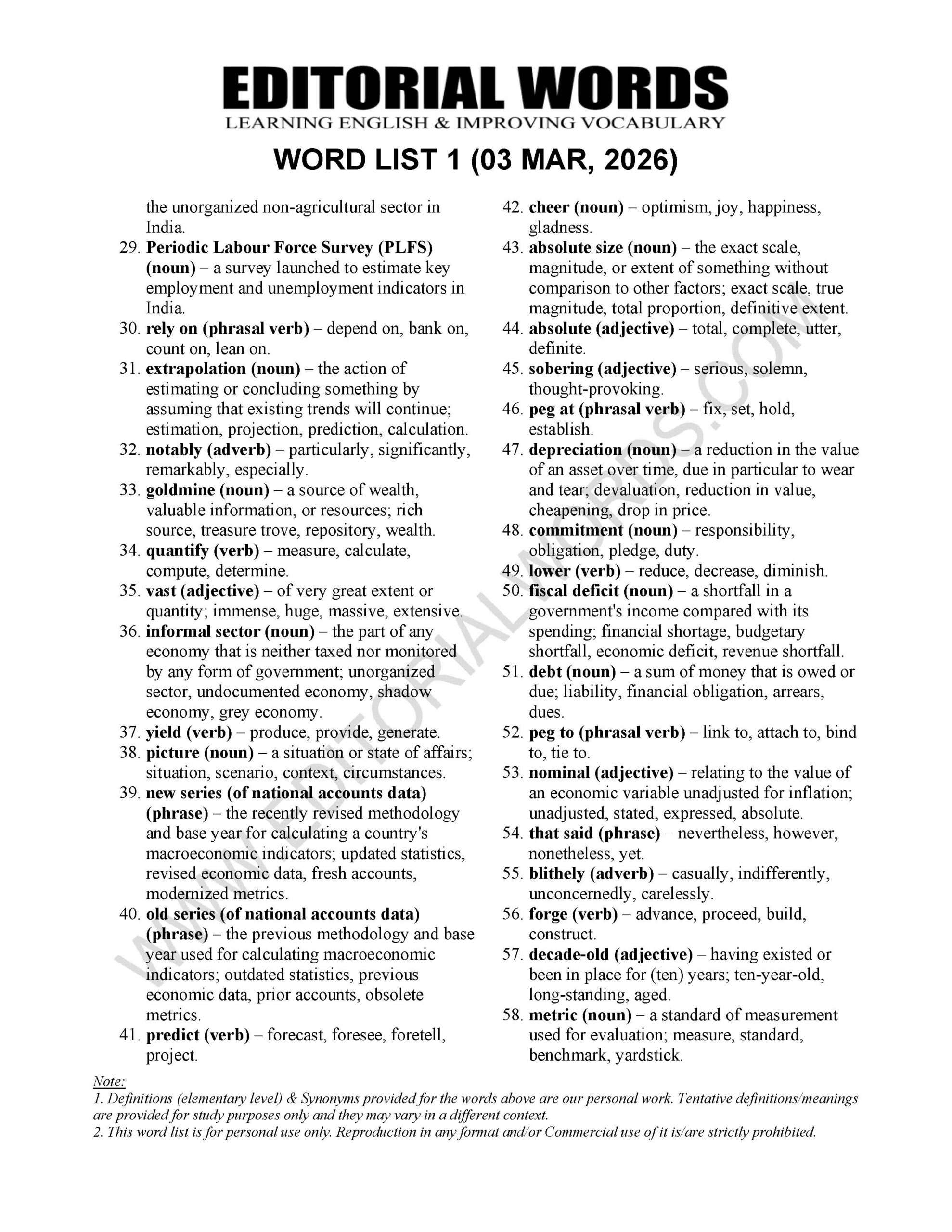
- Periodic Labour Force Survey (PLFS) (noun) – a survey launched to estimate key employment and unemployment indicators in India.
- rely on (phrasal verb) – depend on, bank on, count on, lean on.
- extrapolation (noun) – the action of estimating or concluding something by assuming that existing trends will continue; estimation, projection, prediction, calculation.
- notably (adverb) – particularly, significantly, remarkably, especially.
- goldmine (noun) – a source of wealth, valuable information, or resources; rich source, treasure trove, repository, wealth.
- quantify (verb) – measure, calculate, compute, determine.
- vast (adjective) – of very great extent or quantity; immense, huge, massive, extensive.
- informal sector (noun) – the part of any economy that is neither taxed nor monitored by any form of government; unorganized sector, undocumented economy, shadow economy, grey economy.
- yield (verb) – produce, provide, generate, supply.
- picture (noun) – a situation or state of affairs; situation, scenario, context, circumstances.
- new series (of national accounts data) (phrase) – the recently revised methodology and base year for calculating a country’s macroeconomic indicators; updated statistics, revised economic data, fresh accounts, modernized metrics.
- old series (of national accounts data) (phrase) – the previous methodology and base year used for calculating macroeconomic indicators; outdated statistics, previous economic data, prior accounts, obsolete metrics.
- predict (verb) – forecast, foresee, foretell, project.
- current (adjective) – present, ongoing, present-day.
- cheer (noun) – a feeling or expression of optimism, joy, or encouragement; optimism, joy, happiness, gladness.
- absolute size (noun) – the exact scale, magnitude, or extent of something without comparison to other factors; exact scale, true magnitude, total proportion, definitive extent.
- absolute (adjective) – total, complete, utter, definite.
- sobering (adjective) – making one feel serious and thoughtful; serious, solemn, thought-provoking.
- peg at (phrasal verb) – fix, set, hold, establish.
- depreciation (noun) – a reduction in the value of an asset over time, due in particular to wear and tear; devaluation, reduction in value, cheapening, drop in price.
- commitment (noun) – responsibility, obligation, pledge, duty.
- lower (verb) – reduce, decrease, diminish, cut.
- fiscal deficit (noun) – a shortfall in a government’s income compared with its spending; financial shortage, budgetary shortfall, economic deficit, revenue shortfall.
- debt (noun) – a sum of money that is owed or due; liability, financial obligation, arrears, dues.
- peg to (phrasal verb) – link to, attach to, bind to, tie to.
- nominal (adjective) – relating to the value of an economic variable unadjusted for inflation; unadjusted, stated, expressed, absolute.
- that said (phrase) – even so or despite what has just been said; nevertheless, however, nonetheless, yet.
- blithely (adverb) – casually, indifferently, unconcernedly, carelessly.
- forge (verb) – advance, proceed, build, construct.
- decade-old (adjective) – having existed or been in place for (ten) years; ten-year-old, long-standing, aged.
- metric (noun) – a standard of measurement used for evaluation; measure, standard, benchmark, yardstick.
1. Click each one of the words above for their definition, more synonyms, pronunciation, example sentences, phrases, derivatives, origin and etc. from http://www.oxforddictionaries.com/.
2. Definitions (elementary level) & Synonyms provided for the words above are my personal work and not that of Oxford University Press. Tentative definitions/meanings are provided for study purposes only and they may vary in a different context.
3. This word list is for personal use only. Reproduction in any format and/or Commercial use of it is/are strictly prohibited.
The Hindu Editorial (New reality) – Mar 03, 2026:
“Idioms & Phrases” We Learnt Last Week
“Important Definitions” We Learnt Last Week
Recent Word Lists For The Hindu Editorial Articles
The release of the new series of national accounts data is a heartening improvement to India’s key economic statistics, but the data highlights some aspects that merit policy attention… For further reading, visit “The Hindu”. Below is today’s word list-1 for The Hindu Editorial (New reality) – Mar 03, 2026.